





What Exactly is a 'Fire Rainbow'?
Despite its evocative name, a 'fire rainbow' has nothing to do with fire. The term is an informal name for a rare and beautiful optical phenomenon technically called a circumhorizontal arc. The name likely comes from its vibrant, flame-like appearance
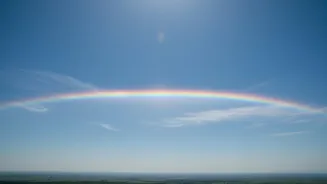
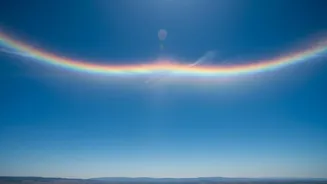
when it appears in wispy, fragmented cirrus clouds. These arcs are vast, colourful bands that run parallel to the horizon, often appearing so large that they can be mistaken for the sky itself. The colours are exceptionally pure, often more distinct than those seen in a typical rainbow.
The Perfect Recipe of Ice and Light
The formation of a circumhorizontal arc requires a very specific set of ingredients, which is why they are so unusual to see. First, the sun must be very high in the sky, at an altitude of 58 degrees or more above the horizon. This condition means the phenomenon is most often seen in the middle of summer at mid-latitudes and cannot be seen at all in locations above 55 degrees latitude. The second crucial ingredient is the presence of high-altitude cirrus clouds. These thin, wispy clouds, found at altitudes where temperatures are extremely low, are composed not of water droplets, but of tiny, plate-shaped hexagonal ice crystals. For the arc to form, these millions of tiny ice crystals must be aligned horizontally, acting like a collective of floating prisms.
How It's Different from a Rainbow
While both phenomena split sunlight into a spectrum of colours, the physics behind them are quite different. A traditional rainbow is formed when sunlight passes through liquid water droplets, usually raindrops. The light refracts as it enters a droplet, reflects off the back of it, and then refracts again as it leaves, always appearing in the sky opposite the sun. A circumhorizontal arc, however, is formed purely by the refraction of light through ice crystals. Sunlight enters a vertical side face of a flat, hexagonal ice crystal and exits through the bottom horizontal face. This 90-degree bending of light separates the light into its constituent colours, creating the vibrant arc that always appears below the sun, parallel to the horizon.
NASA's Spectacular Capture
The image featured as NASA's Astronomy Picture of the Day on August 2nd was a spectacular example captured over North Fork Mountain in West Virginia, although the photo itself was taken in 2021. NASA uses its daily feature to highlight fascinating cosmic and atmospheric events, providing explanations written by professional astronomers. In this case, the image beautifully illustrates how the distant cirrus fibratus clouds, filled with perfectly aligned ice crystals, acted as prisms to create the stunning, flame-like arc. Such images are not just beautiful but serve as a valuable tool for public education, demystifying complex atmospheric optics and reminding us of the intricate science that governs the world above.
A Rare and Fleeting Sight
Seeing a circumhorizontal arc is a matter of being in the right place at the right time. The strict requirements—a high sun angle and the presence of specific cirrus clouds with correctly oriented plate-like ice crystals—make them an uncommon sight. They are more frequently seen during the summer months in mid-latitude regions. For example, the sun is high enough for a potential sighting for hundreds of hours per year in Los Angeles, but only for about 140 hours in London. The phenomenon should also not be confused with cloud iridescence, which can create similar rainbow-like colours in clouds but through a different process called diffraction, resulting in more random, washed-out colour patterns.