

A Cosmic Numbers Game
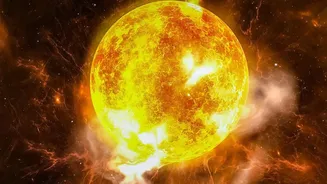
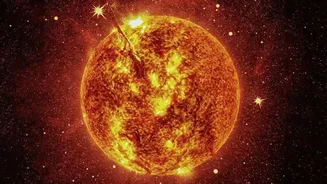
When a massive star, at least eight times the mass of our sun, runs out of fuel, its core collapses under its own immense gravity. This collapse triggers a cataclysmic explosion known as a core-collapse supernova, an event so bright it can briefly outshine
its entire galaxy. These explosions are crucial for seeding the universe with heavy elements. Based on the number of massive stars we see, astronomers predict there should be one or two supernovae in a galaxy like our Milky Way every century. Yet, we observe far fewer. For decades, this discrepancy has been a major puzzle. Where are all the missing explosions?
The Rise of the 'Failed' Supernova
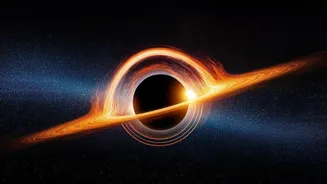
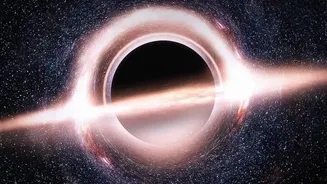
One leading theory is that not all massive stars succeed in exploding. For the most massive stars, those upwards of 17 to 25 times the mass of the sun, gravity's pull might be simply too strong. Instead of a brilliant explosion, the star's core collapses directly into a black hole, swallowing the rest of the star with it. This event, known as a 'failed supernova' or 'unnova', would be optically dim, with the star appearing to simply vanish from sight. Astronomers have found a few compelling candidates for this process by watching stars seemingly disappear, supporting the idea that a significant fraction—perhaps up to 30%—of massive stars end their lives with a whimper, not a bang.
Enter the Ghostly Detective
So how do you find an explosion that you can't see? The answer may lie with neutrinos. These nearly massless 'ghost particles' are produced in unfathomable numbers during a star's core collapse, carrying away about 99% of the event's energy. Because they barely interact with other matter, they escape the dying star's core instantly, hours before any light from a potential explosion would emerge. This means that even a 'failed' supernova, which produces little to no light, should still unleash a massive burst of neutrinos. Detecting this burst would be the tell-tale sign of a star's hidden demise.
An Early Warning System for the Cosmos
Around the globe, a network of deep underground detectors forms the Supernova Early Warning System (SNEWS). Facilities like Super-Kamiokande, IceCube, and the upcoming JUNO observatory are designed to catch these elusive neutrino bursts. If two or more detectors register a spike in neutrinos within seconds of each other, an alert is automatically sent to astronomers worldwide. This gives optical telescopes a heads-up to search for a visible supernova or, in the case of a failed one, to look for a star that has just disappeared. The last time a supernova was close enough to be detected this way was SN 1987A, which produced just 24 neutrino events across three detectors. A future event in our own galaxy is expected to generate thousands, providing a wealth of data.
Building a Better Explosion
The other half of the solution lies inside supercomputers. For years, scientists have tried to simulate supernova explosions, but early 2D models often failed to produce a successful blast; they would simply fizzle out. It turns out the third dimension is critical. Recent, highly realistic 3D simulations show that the process is far more chaotic and asymmetric than previously thought, with turbulent plumes of superheated material playing a key role in pushing the explosion outward. These advanced models, which simulate everything from the initial collapse to the spreading debris months later, are helping physicists understand the fine line between a successful explosion and a failed one. By refining the physics, including neutrino interactions and nuclear reaction rates, these simulations can provide a more accurate theoretical prediction of the supernova rate to compare against observations.