






An Unplanned Lunar Encounter
The story begins in January 2025 with the launch of a SpaceX Falcon 9 rocket. Its mission was to deliver two commercial lunar landers into space as part of NASA's initiative to commercialize lunar exploration. While the rocket's primary booster returned
to Earth for reuse, the upper stage, having spent its fuel, was left in a high orbit. Typically, these stages are directed to burn up in Earth's atmosphere, but pre-planned maneuvers failed. Over the next year, the combined gravitational pulls of the Earth, Moon, and Sun nudged the four-tonne, 45-foot-long piece of space junk onto an unalterable collision course with the Moon. On August 5, 2026, the inevitable happened: the rocket stage struck the lunar surface at a blistering 5,400 miles per hour.
The Hunt for the Crater
Even though astronomers predicted the impact, finding the resulting crater was a significant challenge. The crash occurred on the Earth-facing side of the Moon, but without a visible flare from Earth, confirmation required a space-based observer. This is where international cooperation came into play. NASA's Center for Near Earth Object Studies refined trajectory predictions and provided the location to the team behind South Korea's Danuri lunar orbiter. Just hours after the impact, Danuri became the first spacecraft to image the site, confirming the predictions were accurate to within a kilometer. This provided crucial coordinates for the main event: a detailed follow-up by NASA's own Lunar Reconnaissance Orbiter (LRO).
NASA's Lunar Detective Gets the Shot
Capturing the definitive images was a feat of orbital mechanics. The LRO circles the Moon from pole to pole every two hours, traveling at about a mile per second roughly 60 miles above the surface. Flight controllers had to wait six days for the crash site to rotate into the orbiter's view. They then tilted the entire spacecraft to point its powerful cameras at the precise location. The timing had to be perfect; being off by even ten seconds would mean missing the target by ten miles. Between August 11 and 12, the LRO successfully captured a series of high-resolution, before-and-after images, providing the clearest view of the impact's aftermath.
What the Images Revealed
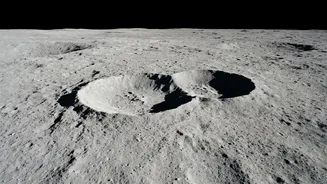
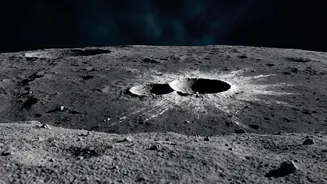
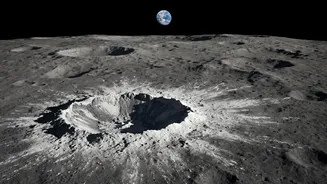
The LRO's new photographs resolved the immediate mystery of the crash site. They show a newly formed crater approximately 60 feet (18 meters) wide and less than 10 feet deep. The images, taken from various angles and under different lighting, reveal fascinating details about the lunar soil, or regolith. Darker streaks fan out from the impact zone; this is older surface material that has been weathered by solar wind and cosmic rays over eons. Closer to the rim, brighter streaks are visible. This is fresh, unweathered material excavated from deeper underground by the force of the collision. By analyzing this ejecta pattern, scientists get a rare, albeit accidental, look at the Moon's subsurface composition.
An Accidental Science Experiment
While SpaceX noted the crash was unintentional, stating they follow all regulations for disposing of space hardware, the event has become a valuable scientific opportunity. A NASA scientist noted that lunar surface impacts are an accepted method of hardware disposal and can be a predictable strategy. In fact, NASA intentionally crashed a probe into the Moon in 2009 to search for water ice. This accidental impact provides a different kind of data, allowing researchers to study how man-made objects of a known size and mass create craters. This information is crucial for understanding the increasing number of artificial objects in lunar orbit and for protecting future missions and potential lunar bases from space debris.