
The Puzzle of the Red Dots
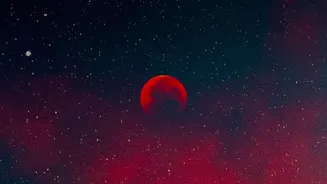
Since it began operations, the James Webb Space Telescope (JWST) has been spotting tiny, yet intensely bright, red specks in the deepest images of our universe. These objects, officially dubbed 'Little Red Dots' or LRDs, appear to be from a time just
600 million to 1.6 billion years after the Big Bang. Their existence is a major cosmic puzzle. They are far too luminous to be ordinary young galaxies, which shouldn't have had enough time to form so many stars. The leading theory was that they were the bright cores of galaxies powered by supermassive black holes, known as active galactic nuclei (AGN) or quasars. But there was a problem: these LRDs didn't emit the powerful X-rays that are a classic signature of a black hole actively feeding. So, what were they?
Introducing the 'Black Hole Star'
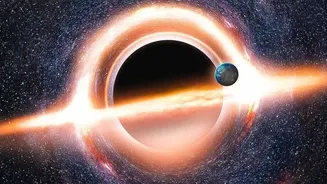
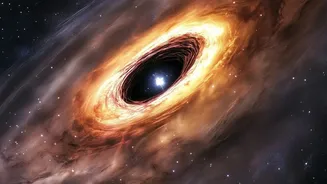
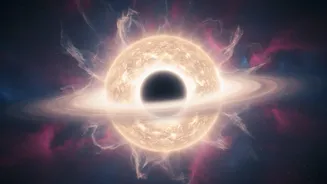
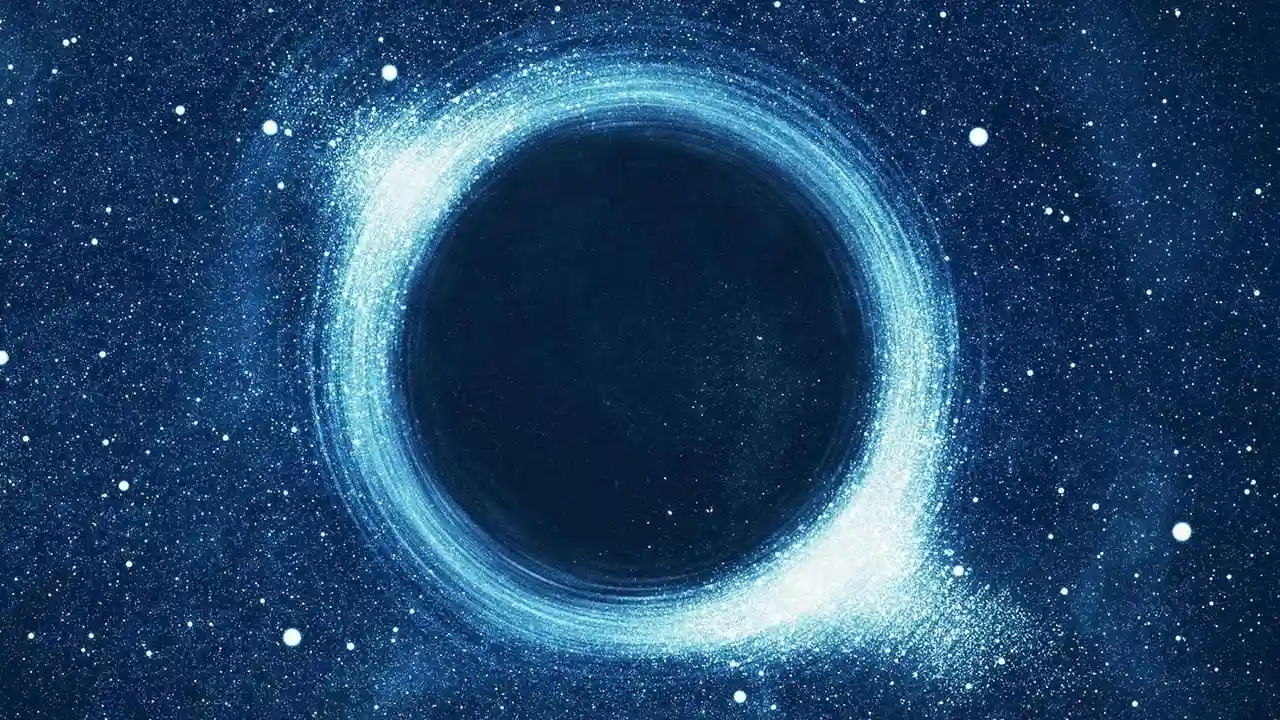
The answer may lie in a new, fascinating and previously theoretical type of celestial object: a 'black hole star'. Don't mistake this for a star that has collapsed into a black hole. Instead, imagine a supermassive black hole in the infant universe, growing at a furious pace. It's pulling in so much gas and dust that it becomes shrouded in a massive, dense cocoon of this material. This gaseous envelope becomes so thick and hot from the black hole's energy that it swells up and glows like a star, but on a scale far larger than any normal star. This entire package—the hidden black hole and its glowing gas shroud—is what scientists are now calling a black hole star. One specific object, named MoM-BH*-1, is considered a prime example, appearing as a pure point of 'black hole star' light.
Connecting the Dots
This 'black hole star' model elegantly solves the mysteries of the LRDs. The immense brightness comes from the supermassive black hole at its core, which is feasting on matter and releasing incredible amounts of energy. The characteristic red colour and the lack of X-rays are explained by the dense gas cocoon. This shroud acts like a cosmic filter, absorbing the high-energy ultraviolet light and X-rays from the black hole's accretion disk and re-emitting the energy at longer, redder wavelengths. It perfectly explains why JWST sees a bright red dot instead of a classic quasar. Detailed analysis of another LRD, named GLIMPSE-17775, revealed over 40 spectral signatures that all point towards this black hole star model, making the case stronger than ever.
Rewriting Early Cosmic History
This discovery does more than just solve a puzzle; it provides a crucial new chapter in the story of the universe. One of the biggest questions in cosmology is how supermassive black holes, millions or billions of times the mass of our sun, grew so large so quickly after the Big Bang. Standard theories suggested they shouldn't have had enough time. The black hole star model offers a solution. It suggests that the first supermassive black holes went through a rapid, messy growth phase, hidden from view inside these gaseous cocoons. They were effectively growing in stealth mode. These LRDs are not just oddities; they are snapshots of the universe's most massive black holes during their tumultuous teenage years, before they burned off their gaseous shrouds to reveal themselves as the brilliant quasars seen in the slightly later universe.