







A Galactic Neighbor's Hidden Story
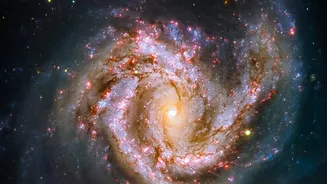
At a mere 2.5 million light-years away, the Andromeda galaxy is our closest major galactic neighbor and a familiar sight in the night sky. For decades, astronomers viewed it as a vibrant, sprawling spiral similar to our own Milky Way, bustling with activity.
It experienced a dramatic burst of star formation about two billion years ago, likely the result of a merger with a smaller galaxy. However, a groundbreaking new study using years of data from the Hubble Space Telescope has painted a different, more complex picture. By creating a detailed stellar map of nearly 200 million individual stars, scientists have uncovered that Andromeda is entering its 'middle age', transitioning from a lively hub of star birth to a more quiescent, or retired, state.
Reading the Fossil Record of Stars
To understand a galaxy's history, astronomers study its stars, which act as a fossil record. Massive, young stars burn hot and appear blue, but they have short lifespans. Older, less massive stars are cooler and glow red, living much longer. By analyzing the color and distribution of stars across Andromeda's disk, researchers can rewind time and map its star-forming activity. The recent analysis revealed a steady decline over the last 500 million years. During that period, the rate of star formation dropped from about one solar mass per year to half that rate by 40 million years ago. Today, the activity has plummeted even further, to just one-fifth of a solar mass per year.
The Ring of Fading Fire
Contrary to what one might expect, the decline isn't happening uniformly across the galaxy. Much of Andromeda's most recent star-making has been concentrated in a brilliant, vast ring located about 32,000 light-years from the galactic center. This is where the headline's paradox comes into play. While this feature appears as a dazzling highlight, it is also where the slowdown in star birth is most pronounced. The decline in activity within this very ring is the primary driver of the galaxy's overall downturn. Researchers believe this isn't due to a lack of raw materials like gas and dust, but rather a natural winding-down phase after its more active youth. Lead author Tobin Wainer compared it to taking a breather after running a marathon.
A Case of Galactic Interference
Another piece of the puzzle involves Andromeda's small satellite galaxy, M32. The study found a virtual 'dead zone' with very little star formation in the part of Andromeda's disk closest to where M32 is located. This suggests that M32 may have punched through Andromeda's disk around 60 million years ago, disrupting the gas clouds necessary for new stars to ignite and essentially sterilizing that region. While researchers can't definitively blame M32, its presence in the right place at the right time makes it a prime suspect for contributing to the localized shutdown of stellar nurseries.