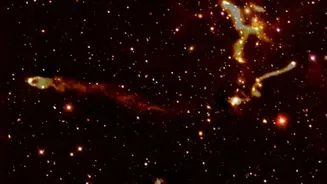







Meet the Microblazar
Imagine a black hole, not one of the supermassive giants at the center of a galaxy, but a smaller one, just a few times the mass of our Sun. Now, picture it in a tight dance with a companion star, siphoning off gas like a cosmic vampire. This process
creates a swirling, superheated disc of material around the black hole. While much of this matter is doomed to fall in, some is channeled by intense magnetic fields and blasted out from the black hole's poles in two narrow, opposing jets of plasma travelling at nearly the speed of light. This entire system is known as a microquasar. But if one of those jets happens to be pointed almost directly at Earth, scientists call it a 'microblazar'. This special orientation makes the system appear extraordinarily bright due to an effect called relativistic beaming, turning a faint object into a cosmic spotlight.
A Galactic Ghost Hunt
While astronomers have studied their larger cousins, 'blazars', for decades, finding a microblazar in our own Milky Way has been a long and frustrating search. Blazars are powered by supermassive black holes millions of times more massive than the Sun, and their jets can stretch for millions of light-years. Microblazars are the miniature, local versions. The challenge in finding them is twofold. First, the precise alignment needed for a jet to point directly at us is a matter of sheer geometric luck, making them inherently rare. Second, the evolutionary phase in which a black hole actively pulls material from its companion is relatively short, meaning astronomers have to catch them at just the right time. Many candidates over the years have failed to hold up to scrutiny, leaving these local powerhouses as theoretical predictions more than observational facts.
A New Contender Emerges
An international team of astronomers has now identified what they call the strongest candidate yet for a Milky Way microblazar. The system, named IRAS 18293-0941, is located about 12,000 light-years from Earth. It consists of a black hole roughly 10 times the mass of the Sun orbiting a large companion star every 11 days. For decades, this system was hidden in plain sight, obscured by a thick curtain of interstellar dust that made it virtually invisible to optical telescopes. It was first cataloged in the 1980s but largely forgotten until recent, multi-wavelength observations pieced together its true nature. Radio telescope data revealed a telltale, one-sided jet—the signature of a beam of energy pointing directly toward us, with its opposite number aimed away and thus appearing much fainter.
A Natural Particle Accelerator
The discovery of IRAS 18293-0941 is more than just checking an item off an astronomical wish list. It provides an unprecedented natural laboratory for studying some of the most extreme physics in the universe. Because it's in our own galaxy, it is thousands of times closer than the nearest supermassive blazars, allowing for far more detailed study. Scientists can observe how these jets are launched and how they interact with their surroundings on much shorter timescales. Intriguingly, the jet from this system appears to be slamming into a dense cloud of interstellar gas about 100 light-years away, creating a hotspot of particle acceleration. This interaction creates particles with energies far exceeding what can be achieved at the Large Hadron Collider on Earth, potentially making this microblazar one of the most powerful particle accelerators in our galaxy.