




A New Cosmic Quest
Scientists from institutions like the University of Southampton and The Open University have launched a major citizen science project to uncover our galaxy's hidden black holes. Hosted on the popular Zooniverse platform, Black Hole Hunters empowers anyone,
regardless of their background, to contribute to cutting-edge astronomical research. While astronomers estimate there could be over 10 million stellar-mass black holes in the Milky Way, the actual number of confirmed discoveries remains incredibly small. This project aims to dramatically close that gap by harnessing the power of the crowd to sift through vast amounts of data that would take professional researchers years to analyse on their own. The mission is simple: find the tell-tale signs of these invisible giants hiding in plain sight.
The Universe's Invisible Giants
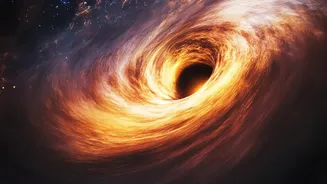
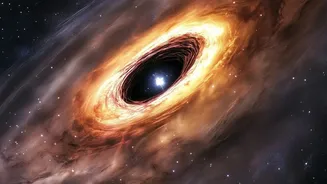
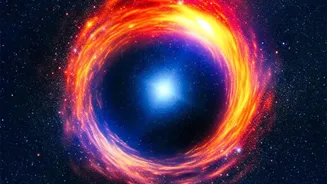
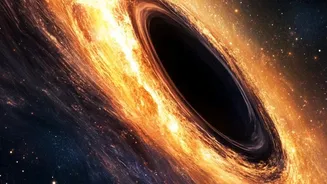
So, what makes these black holes 'hidden'? Unlike the supermassive black holes at the centres of galaxies or those actively feeding on nearby stars, these objects are often dormant. They aren't swallowing matter, so they don't emit the bright X-rays that typically give away their location. The Black Hole Hunters project is looking for black holes that are part of a binary system, orbiting a companion star. Because a black hole's gravity is so immense, it can bend and warp the fabric of spacetime. As it passes in front of its companion star from our point of view, its gravity acts like a cosmic magnifying glass, briefly making the star appear brighter. This phenomenon, known as gravitational microlensing, creates a distinct pattern in the star's light—a unique flicker that can signal the presence of an unseen black hole.
Your Mission, Should You Choose It
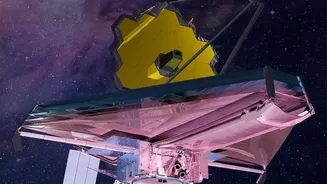
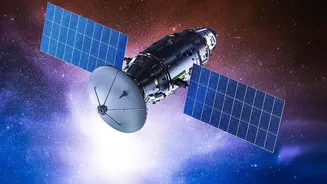
Becoming a black hole hunter is surprisingly straightforward. Volunteers are given data from NASA's Transiting Exoplanet Survey Satellite (TESS), a powerful space telescope that continuously monitors the brightness of millions of stars. The research team uses artificial intelligence to pre-process this data, flagging about a million potential candidates that show interesting variations in light. This is where human volunteers come in. Your task is to look at simple graphs, called 'light curves', that show a star's brightness over time. You don't need to do any complex maths. The project provides training and examples of the specific symmetrical peak shape that indicates a potential lensing event. Your job is to use your pattern-recognition skills to spot these signals, which can be more reliable than algorithms at distinguishing them from other stellar activity.
The Power of the Crowd
This project is a perfect example of why citizen science is becoming indispensable in the age of big data. Modern telescopes like TESS generate an overwhelming amount of information, more than any single research team could analyse. While AI is a powerful tool for an initial filter, the human eye remains uniquely skilled at identifying subtle patterns and flagging unusual signals that automated systems might miss. Each classification you make, whether it identifies a candidate or rules one out, helps astronomers refine their search. When enough volunteers flag the same object, it gets prioritised for follow-up observations by professional observatories. By contributing, you are directly helping scientists decide where to point their telescopes next and potentially making a discovery that could change our understanding of the galaxy.
How to Join the Hunt
Getting started is easy and can be done from any computer, tablet, or smartphone with an internet connection. Simply go to the Zooniverse website and search for the 'Black Hole Hunters' project. You will be greeted with a brief tutorial that walks you through what to look for in the light curves. After that, you can immediately start classifying real astronomical data. You can dedicate as little or as much time as you like; every single contribution helps. According to the researchers, anyone who participates might be the one to find the very first black hole in a self-lensing system. It's a chance to take part in a genuine cosmic treasure hunt and make a real contribution to our map of the universe.