


The Sobering Numbers
On September 14, 2026, Antarctic sea ice reached its annual maximum extent, covering 17.59 million square kilometres of the Southern Ocean. While this sounds vast, it is a staggering one million square kilometres below the long-term average—an area roughly
twice the size of Spain is missing its ice cover. This measurement, confirmed by scientists at the National Snow and Ice Data Center (NSIDC), marks the third-lowest winter peak in the nearly 48-year satellite record. More alarmingly, it continues a disturbing pattern: the four lowest winter maximums ever recorded have all occurred in the last four years. This is a clear signal to researchers that the relative stability once observed in Antarctica may be giving way to a new, more volatile state.
A Puzzle in the South
For decades, Antarctic sea ice behaved differently from its Arctic counterpart. While the Arctic has seen a steady, dramatic decline in sea ice, the Antarctic experienced decades of modest expansion, peaking with a record maximum in 2014. This variability made it a puzzle for climate scientists. However, starting around 2016, the trend abruptly reversed, leading to a series of record and near-record lows. Scientists are now racing to understand if this is a temporary blip caused by natural variability or a fundamental regime shift driven by global warming. Unlike a single record-low year, a consistent pattern of low winters suggests a more persistent change in the system.
The Search for a Cause
There is no single, simple answer to why Antarctic sea ice is shrinking, but scientists have several leading theories. One major culprit is believed to be warmer ocean water. Heat from the deeper ocean, potentially brought to the surface by changing wind patterns, may be inhibiting ice formation from below. Natural climate patterns like El Niño are also thought to play a role by altering atmospheric circulation and storms around the continent. For years, a layer of less salty, fresher water at the ocean's surface may have insulated the sea ice from the warmer, saltier water below. Now, it appears this protective barrier may be weakening, allowing that deep ocean heat to finally reach the surface and melt the ice.
A Global Domino Effect
The loss of Antarctic sea ice has consequences that ripple across the globe. Sea ice acts as a planetary air conditioner by reflecting the sun's energy back into space. When dark ocean water replaces bright white ice, more heat is absorbed, creating a feedback loop that accelerates warming. While melting sea ice doesn't directly raise sea levels because it's already floating, its absence has an indirect and crucial effect. The ice pack acts as a protective buffer for the continent's massive land-based ice shelves. Without it, these shelves are exposed to wave action and warmer ocean temperatures, which can lead to fracturing, increased iceberg calving, and an accelerated flow of land ice into the sea—a direct contributor to global sea-level rise.
An Ecosystem on the Brink
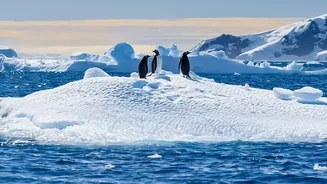
The changes are not just physical; they represent an existential threat to Antarctica’s unique ecosystem. The entire food web is built on a foundation of sea ice. It provides critical habitat for algae and krill, the tiny crustaceans that are the primary food source for whales, seals, and penguins. A reduction in krill populations can lead to starvation for the animals that depend on them. For species like emperor penguins, which use stable sea ice to breed and raise their chicks, an earlier melt can be catastrophic, leading to drowning and breeding failure. The rapid shift is forcing a biological reorganisation in one of the world's most vital marine environments.