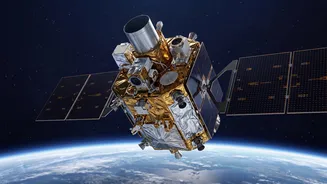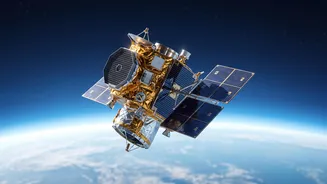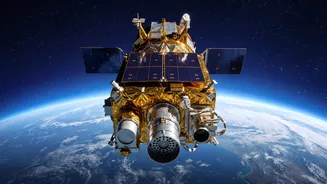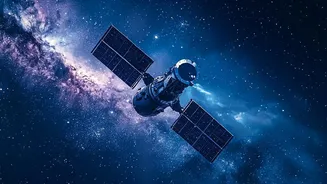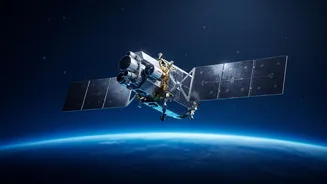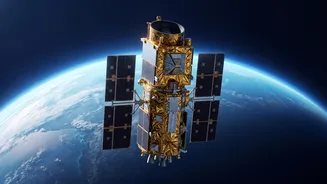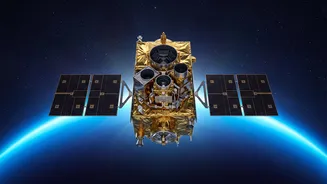





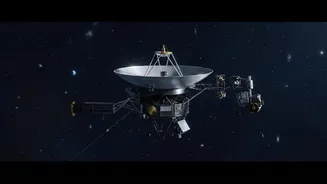
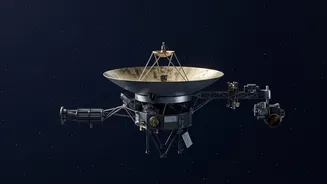
After nearly 22 years of unlocking the secrets of the cosmos, NASA’s Neil Gehrels Swift Observatory came home in a fiery spectacle on November 4. But this was no controlled landing; it was an inevitable fall, orchestrated by an invisible force.
A Fiery End for a Storied Telescope
On Wednesday,
November 4, 2026, the Swift spacecraft plunged through Earth's atmosphere, ending its long and decorated mission. The U.S. Space Force confirmed the re-entry occurred at 7:39 a.m. EST over the North Sumatra region of Indonesia. Like most satellites returning to Earth, the 1,450 kg observatory was expected to mostly burn up due to the intense heat and friction of its high-speed descent. While some durable components might survive the journey, the overall risk to anyone on the ground was deemed extremely low. The event marked the conclusion of what was originally a two-year mission that stretched for more than two decades, providing invaluable data on the universe's most violent explosions.
The Invisible Force: What Is Atmospheric Drag?
The culprit behind Swift’s descent is a phenomenon called atmospheric drag. While we think of space as a perfect vacuum, the upper layers of Earth’s atmosphere, like the thermosphere and exosphere, still contain gas particles. For a satellite in Low Earth Orbit (LEO) like Swift, moving at incredible speeds of over 7 km/s, colliding with these particles creates a constant, subtle friction. Think of it like the air resistance you feel when you stick your hand out of a moving car window, but happening continuously for years. This drag slowly saps the satellite's kinetic energy, causing its altitude to decrease over time in a process known as orbital decay. As the satellite sinks lower, the atmosphere becomes denser, which in turn increases the drag, accelerating the decay in a feedback loop that eventually leads to re-entry.
A Legacy of Cosmic Discovery
Launched in November 2004, the Swift Gamma-Ray Burst Explorer was a game-changer. Its primary mission was to study gamma-ray bursts (GRBs), the most powerful explosions in the universe, which can occur when massive stars collapse into black holes. The satellite was aptly named not as an acronym, but for its ability to 'swiftly' pivot its trio of telescopes to catch the fleeting afterglow of these events in X-ray, ultraviolet, and optical light. This rapid response allowed scientists to study GRBs in unprecedented detail. Over its 22-year lifespan, Swift far outlived its initial two-year plan, observing thousands of GRBs and broadening our understanding of everything from supernovas and black holes to comets in our own solar system.
An Uncontrolled But Inevitable Fall
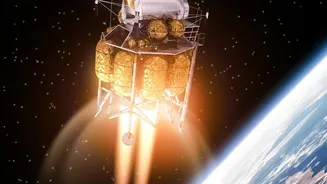
Unlike larger spacecraft such as the International Space Station, Swift had no onboard propulsion system to perform 'station_keeping' manoeuvres — periodic boosts to counteract orbital decay. Its fate was sealed from the moment it launched. An increase in solar activity in recent years also played a role, causing Earth’s atmosphere to expand and increase the drag on the aging satellite. An ambitious private rescue mission was attempted in mid_2026, where a robotic spacecraft was supposed to rendezvous with Swift and push it into a higher, more stable orbit. However, technical issues with the servicing spacecraft prevented the manoeuvre, and the mission was abandoned in August, leaving Swift to its natural, gravitational end.
Calculating the Risk to People on Earth
The phrase 'uncontrolled re_entry' can sound alarming, but the actual danger to any single person is incredibly small. NASA and other space agencies perform detailed risk assessments for such events. They consider that about 70% of the Earth's surface is water and much of the land is unpopulated. For Swift's re_entry, NASA estimated that while 10–40% of the satellite's mass could potentially survive, the odds of a piece of debris causing harm to anyone were just 1 in 2,100. While individual risk remains extremely low, the sheer number of satellites now in orbit is increasing the collective, global risk from falling debris. This has made the management and de_orbiting of space objects a critical issue for the future of space exploration.