







Trust the Equipment
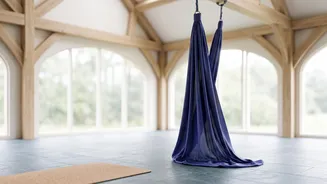
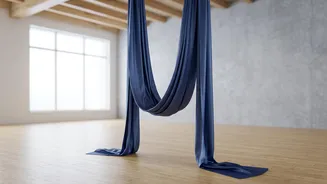
The very first mental hurdle is placing your faith in the vibrant silk hammock hanging from the ceiling. It can feel unnatural to lean back, hang upside down, or put your full body weight into a piece of fabric. Your brain’s self-preservation instinct
might scream 'danger!' This is where your first mental cue comes in: actively tell yourself to trust the equipment. Aerial yoga rigging is designed for safety, with hammocks and ceiling mounts built to hold well over a thousand kilograms. Remind yourself that the studio's primary concern is your safety, and the equipment is more than capable of supporting you. Before you even attempt a pose, take a moment to sit in the hammock, give it a few gentle swings, and feel its strength. This small act helps create a positive feedback loop, reassuring your nervous system that you are secure.
Let Your Breath Be Your Guide
When you’re trying to balance, invert, or wrap yourself into a new shape, it's easy to hold your breath. This tenses your muscles and sends a signal of panic to your brain. Instead, make your breath the focal point. Consciously inhaling and exhaling deeply calms the nervous system and increases focus. In aerial yoga, your breath is a powerful tool for stability. As your instructor guides you into a pose, link your movement to your breath. Use your exhale to deepen a stretch or to settle into an inversion. If you feel a wave of dizziness or disorientation—a common sensation for beginners—return your focus immediately to slow, steady breathing. It anchors you in the present moment and helps your body adjust to the new spatial orientation, turning a moment of discomfort into one of mindful control.
Embrace the Wobble
In your first class, and likely for a few classes after, you are going to wobble. The hammock will sway, and your body will shake as it learns to engage tiny stabilizer muscles you never knew you had. The temptation is to see this instability as a failure, but it’s crucial to reframe it. The wobble is not a sign of weakness; it’s a sign of learning. It’s your body actively creating new neural pathways and building functional strength. Instead of tensing up and fighting the movement, embrace it. Allow the hammock to move. This cue shifts your goal from achieving a perfect, static pose to exploring the dynamic process of finding your balance. This mindset is not only more effective for building strength and stability but also makes the practice much more enjoyable and less stressful.
Listen to Your Body, Not Your Ego
An aerial yoga class can look like a beautiful, acrobatic performance. It’s easy to look at the instructor or more experienced students and feel pressure to keep up. This is where your ego can get in the way of a safe and beneficial practice. The most important mental cue is to listen to your own body’s signals. Aerial yoga is not a competition. Some poses might feel great, while others might feel uncomfortable or inaccessible on a given day. That’s perfectly normal. The fabric can put pressure on different parts of the body, and what feels good for one person may not for another. Pay attention to sensations of sharp pain versus the discomfort of a deep stretch. Honour your limits by taking modifications offered by the instructor, and don't push yourself into a pose that feels wrong. Progress comes from consistent and safe practice, not from forcing your body into a shape it isn't ready for.
Focus on the Sensation
Beginners often get caught up in the aesthetics of a pose, asking, 'Does this look right?' This external focus can create anxiety and detract from the true benefits of the practice. The final mental cue is to shift your attention inward: 'How does this feel?' Aerial yoga offers a wealth of unique physical sensations, from the gentle decompression of the spine in an inversion to the supportive cocoon of the hammock during Savasana. By focusing on the feeling, you transform the practice from a performance into a mindful experience. Notice how the fabric supports you, where you feel the stretch, and the sensation of your muscles engaging. This internal focus enhances the mind-body connection, which is at the heart of any yoga practice. It allows you to appreciate the journey of movement rather than just the destination of a perfect-looking pose, making your session a form of moving meditation.