

The Galaxy's Gravitational Heart
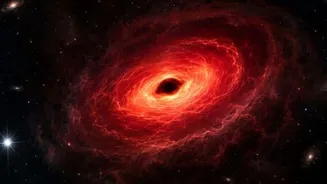
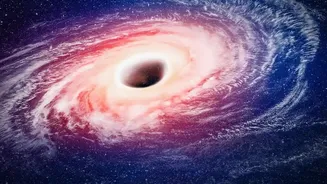
For decades, our model of a galaxy has been relatively straightforward: at the heart of nearly every large galaxy, including our own Milky Way, lies a supermassive black hole (SMBH). Millions or even billions of times the mass of our Sun, these objects
are the gravitational bedrock around which everything else orbits. This isn't to say the black hole's gravity alone holds the galaxy together; that's the job of the galaxy's total mass, including stars, gas, and dark matter. Rather, the extreme density and gravitational forces at the galactic center mean that the heaviest object—the SMBH—naturally sinks and settles there through a process called dynamical friction. It acts like a heavy ball rolling to the lowest point in a bowl. This assumption has been a cornerstone of astrophysics, shaping our understanding of how galaxies form, grow, and evolve over cosmic time.
A Startling Observation
Recent observations have thrown a wrench in this tidy model. An international team of astronomers has identified a supermassive black hole that is conspicuously not at the center of its host galaxy. The discovery in the galaxy J0437+2456, located about 230 million light-years away, revealed an SMBH with a mass of about three million Suns moving at a staggering speed of roughly 177,000 kilometres per hour relative to its galaxy. This isn't a minor offset; the black hole is wandering far from the galactic core where it should be. Spotting such an object is incredibly difficult, as black holes themselves emit no light. Astronomers often find them by detecting the bright flare of energy released when they rip apart a passing star, an event known as a tidal disruption event. It was one such flare that illuminated this 'wandering' black hole, confirming a long-held theory that these cosmic giants could, in fact, be displaced.
The Cosmic Billiards Theory
So, what could give a 'bowling ball' several million times the mass of the Sun such a mighty kick? The leading hypothesis is a tale of galactic cannibalism. Galaxies are not static islands; they frequently collide and merge. When two galaxies merge, their central supermassive black holes are expected to eventually sink to the new galactic center and merge as well. This process can be incredibly messy. If the merger isn't perfectly symmetrical, the gravitational interactions can be chaotic. The smaller black hole might be sent into a wide, oscillating orbit around the new center before it settles down, appearing as a 'wandering' black hole for millions of years. In some scenarios, it's possible that the object we see is one of a pair of black holes, with the second one remaining hidden from our view.
A Kick from Gravitational Waves
An even more exotic explanation involves the very fabric of spacetime. When two black holes finally do merge, they release an immense amount of energy in the form of gravitational waves—ripples in spacetime. If this emission of gravitational waves is lopsided, meaning more energy is radiated in one direction than another, it creates a powerful recoil effect. By the law of conservation of momentum, the newly formed, larger black hole is given a 'kick' in the opposite direction. This gravitational wave recoil can be incredibly powerful, capable of sending the new black hole flying at speeds of millions of kilometres per hour, potentially fast enough to escape its host galaxy entirely. The wandering black hole in J0437+2456 could be a direct result of such a kick, currently on a trajectory that has taken it far from its original home at the galactic core.
Rewriting the Galactic Map
This discovery forces us to reconsider fundamental aspects of galaxy evolution. If supermassive black holes can be displaced or even ejected from their host galaxies, it complicates the tidy relationship between a galaxy and its central engine. Finding these wandering giants validates a new method for hunting otherwise invisible black holes and helps us understand how galaxies are assembled over time. It suggests that the space between galaxies might be littered with rogue black holes, each a remnant of a violent cosmic merger. This single off-center black hole opens a new window into the most extreme gravitational events in the universe, from the dance of merging galaxies to the powerful kick of gravitational waves. Each new wandering black hole discovered will be another clue in solving this fascinating cosmic puzzle.