




Earth’s Glacial Pacemaker
For decades, our understanding of ice ages has been anchored by the Milankovitch cycles. This theory explains that slow, cyclical changes in Earth's orbit, tilt, and wobble alter the amount of solar radiation reaching the planet, pushing it in and out
of long glacial periods over tens of thousands of years. This established model provides a natural clock for the planet, suggesting that after emerging from the last ice age about 11,700 years ago, we should be in a long, stable warm period. Based on these orbital mechanics, the next ice age wasn't expected for many thousands of years. This framework has been fundamental to paleoclimatology, allowing scientists to look deep into the past to understand the large-scale mechanics of our climate system. But recent discoveries suggest this clockwork-like process might be missing some crucial, and more immediate, details.
An Ice Age, Interrupted
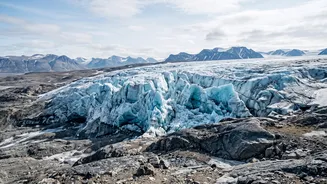
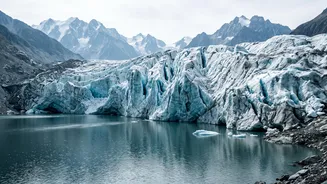
A groundbreaking study is challenging the very definition of when an ice age begins. Research focused on the Barnes Ice Cap on Canada's Baffin Island, the last remnant of the colossal Laurentide Ice Sheet, has yielded a startling discovery. By analyzing ancient plants preserved at the edge of the ice, scientists found that the ice cap actually began to expand again about 2,000 years ago. According to the researchers from the Columbia Climate School, this wasn't just minor growth; it was the start of a new glacial period. This finding directly contradicts models that predicted the next glaciation was tens of thousands of years away. The incipient ice age continued, with the ice expanding until the 1960s. Then, it abruptly stopped and began to retreat. The culprit was the rapid increase in warming from human activities. In effect, we didn't just warm the planet; we may have stopped the next ice age in its tracks.
Rethinking the Speed of Melt
Other new reports are challenging our models of glacial timing in the present day, revealing that ice can melt much faster than we thought. One critical study, from researchers at UC Irvine and NASA, focused on the Thwaites Glacier in Antarctica, often called the 'Doomsday Glacier' for its potential impact on sea levels. Traditional ice sheet models assumed a simple, narrow 'grounding line' where the glacier leaves land and starts floating. However, new satellite data revealed the reality is a much wider 'grounding zone', where warm ocean water can penetrate for kilometers under the grounded ice. This interaction lifts the ice with the tides and accelerates melting from below. By incorporating this more realistic process, the new model projects that Thwaites could contribute up to twice as much to sea-level rise by 2100 than previously estimated—even without any additional global warming.
The Danger of Monthly Averages
Another flaw in our timing models has been the data used to run them. Most global glacier projections have relied on monthly climate data, which smooths out daily weather extremes. However, a recent study published in Nature Communications highlights that glaciers don't respond to monthly averages; they respond to daily weather. A few days of an intense heatwave can melt the protective snow layer on a glacier's surface, exposing darker, less reflective ice underneath. This darker ice absorbs more sunlight, dramatically accelerating melting. Researchers at ETH Zurich found that by using daily weather data, their models projected a 5-10% greater ice loss from glaciers worldwide by the end of the century. This confirms that short-lived, extreme weather events, which are becoming more common, have a lasting and cumulative impact that many older models have been underestimating.