

India's Unblinking Eye on the Sun
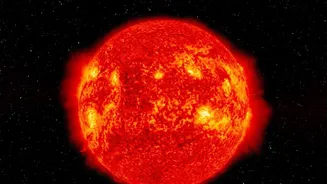
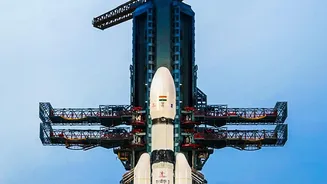
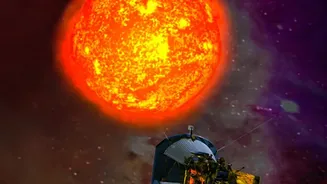
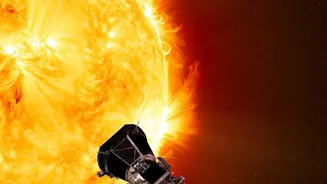
Launched in September 2023, India's Aditya-L1 is the nation's first dedicated solar observatory. Positioned at Lagrange Point 1 (L1), about 1.5 million kilometres from Earth, it has an uninterrupted view of the Sun. Its primary goal is to study the Sun's
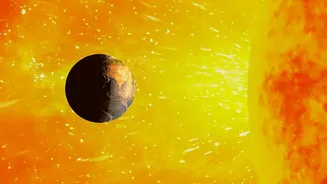
atmosphere—the photosphere, chromosphere, and the enigmatic outer layer, the corona. One of its key instruments, the Visible Emission Line Coronagraph (VELC), is designed to observe the very inner regions of the corona, tracking violent eruptions like Coronal Mass Ejections (CMEs) as they begin. These CMEs are massive expulsions of plasma and magnetic fields from the Sun that can trigger space weather events, disrupting satellites and communications on Earth. Aditya-L1's constant vigil provides a broad, continuous stream of data on the Sun's behaviour.
Europe's Precision Artificial Eclipse
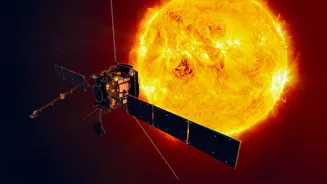
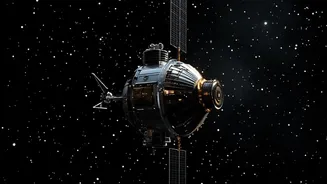
The European Space Agency's (ESA) Proba-3 mission, launched in December 2024, is a marvel of engineering. It is the world's first precision formation-flying mission, consisting of two separate spacecraft flying in a tight, autonomously controlled formation about 150 metres apart. One spacecraft acts as an 'occulter', blocking the bright disc of the Sun, while the other, the 'coronagraph', observes the faint corona. This creates a near-perfect artificial eclipse in space, allowing its ASPIICS instrument to capture incredibly detailed images of the corona much closer to the solar limb than was previously possible. While Aditya-L1's VELC provides spectroscopic data, measuring temperature and density, Proba-3's ASPIICS provides sharp, wide-field images that reveal the shape and motion of solar structures.
A Symphony of Solar Data
The real magic happens when these two missions observe the same event. While not a formal joint mission, scientists have begun to combine their complementary data, creating a more complete picture of solar eruptions than either could achieve alone. In a landmark study, researchers jointly analysed two CMEs captured by both Aditya-L1 and Proba-3 in September 2025. Aditya-L1's VELC provided spectroscopic details about the temperature and density of the erupting plasma, while Proba-3's ASPIICS captured crisp images of the eruption's structure and mass. This overlap allows scientists to cross-validate their findings and build more robust models of how these powerful events unfold. The agreement between their independent measurements of mass and energy lends powerful credibility to the results.
Answering Long-Standing Solar Questions
This collaborative approach directly addresses fundamental, long-standing questions in solar physics. A central mystery is the coronal heating problem: why is the corona, at millions of degrees Celsius, so much hotter than the Sun's surface, which is only about 5,500°C? Another critical question is how CMEs accelerate and evolve in their earliest stages. Observing this region is notoriously difficult due to the Sun's intense glare, which has limited scientists' understanding of how a CME's energy is distributed. By combining Aditya-L1's close-in spectroscopic data with Proba-3's high-resolution imaging, scientists can better track the flow of energy and matter right from the start. This detailed view is crucial for improving space weather forecasting, which is vital for protecting our increasingly technology-dependent world.