







A Millennia-Old Puzzle
The saying 'dripping water hollows out stone' exists in cultures worldwide, a timeless metaphor for the power of persistence. For millennia, however, the literal science has remained a puzzle: How can something as soft as a water droplet inflict damage
on a hard rock? The force of a single drop is far too low to fracture stone on its own. Yet, over time, the impossible happens. A new research project from the University of Santiago de Chile is tackling this exact question. Early findings from the 2026 project, led by researcher Dr. Leonardo Gordillo, have already yielded fascinating insights. His team observed that the erosion process is not immediate; a crater only begins to form after a surface has been struck by 500 to 700 droplets in the same spot. This confirms that the damage is cumulative, but it still leaves the central question of the physical mechanism that makes it possible.
The Shockwave in Every Drop
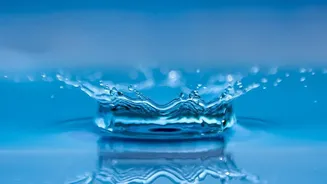
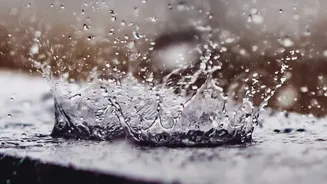
The answer, according to groundbreaking research, lies in the explosive dynamics of the impact itself. A study from the University of Minnesota provided a key breakthrough by using new high-speed imaging techniques to measure the forces hidden beneath an impacting droplet. Researchers discovered that when a droplet hits a surface, it spreads outwards. For a fraction of a second, the edge of this spreading liquid moves faster than the speed of sound, creating a powerful shock wave across the surface. In essence, each raindrop behaves like a microscopic bomb, releasing its impact energy explosively. This intense, localized pressure, previously only theorized, is what gives a soft liquid the force necessary to stress and eventually wear down even the hardest materials over time. This shifts the focus from purely chemical weathering to the immense power of mechanical impact.
More Than Just a Chemical Reaction
For years, our understanding of stone erosion has been dominated by chemical and environmental factors. We know that acid rain, formed by pollutants, can dissolve the calcite in stones like marble and limestone, causing them to crumble and lose detail. We also understand the damage caused by physical processes like the freeze-thaw cycle, where water seeps into pores, freezes, expands, and breaks the stone from within. In drier climates, salt crystals can grow in a similar way, exerting pressure that flakes away the surface. While these agents are undeniably significant, the new research adds a fundamental layer to the story. It shows that even chemically pure rainwater, in a climate that never freezes, can be a powerful erosive force simply through the brute physical stress of countless, repetitive, explosive impacts. This mechanical damage can also create more surface area for chemical agents to attack, accelerating the overall decay.
India’s Heritage in a New Light
This new understanding has profound implications for a country like India, which is home to an unparalleled wealth of ancient stone monuments, temples, and forts. From the intricate sandstone carvings of Rajasthan to the granite temples of the south, this heritage is a testament to the durability of stone. However, it is also exposed to one of the world's most powerful weather phenomena: the monsoon. The sheer volume and intensity of monsoon rainfall mean that these historic structures endure an annual assault of billions upon billions of these tiny shockwaves. This research reframes the threat. It is not just about the chemical composition of the rain, but the relentless physical battery. Understanding this mechanism is vital for conservators working to protect landmarks from further degradation. It could inform the development of new protective coatings designed not just to repel water, but to withstand the shock of impact.