

Our Cosmic Next-Door Neighbor
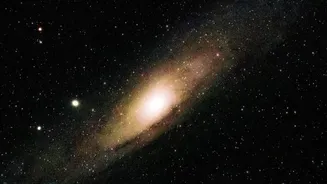
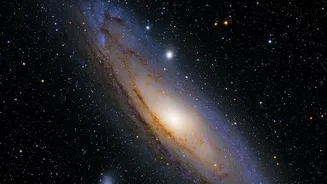
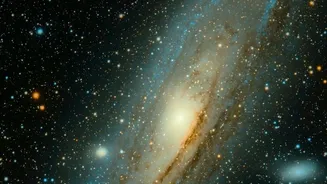
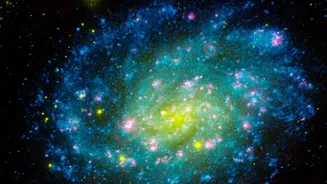
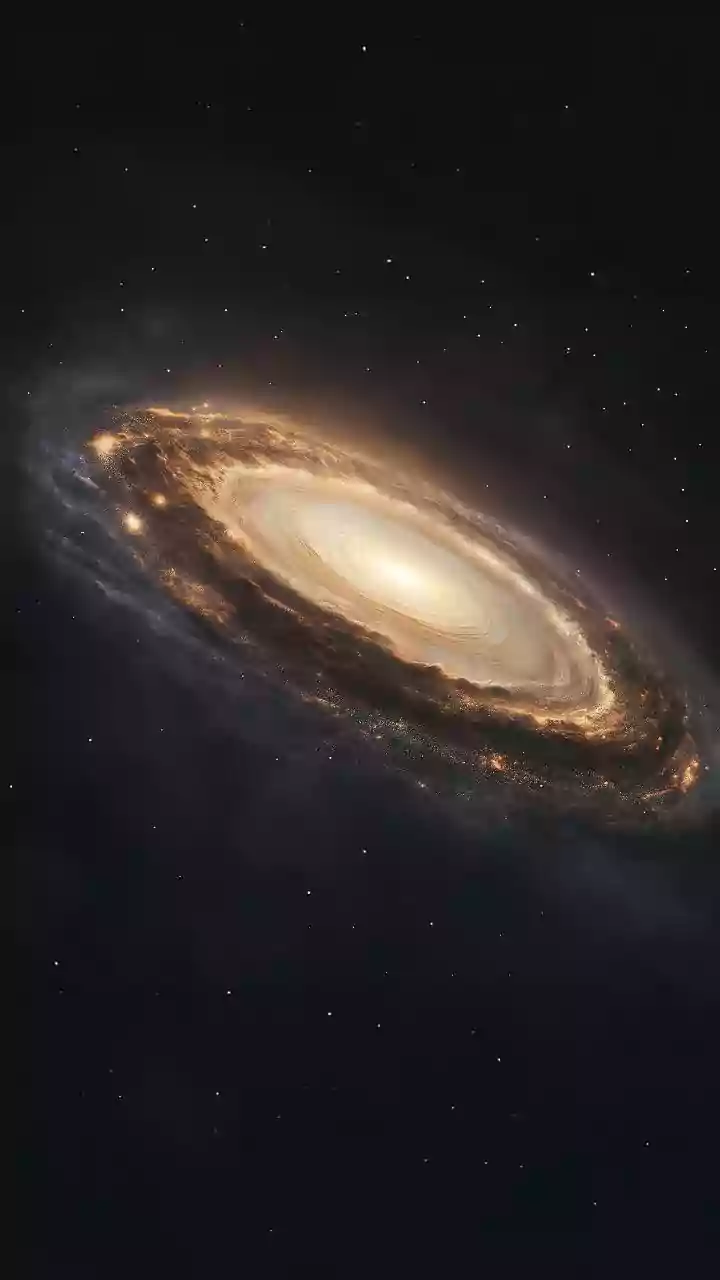
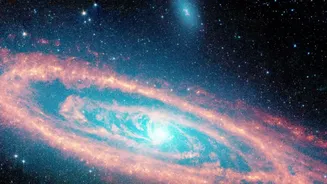
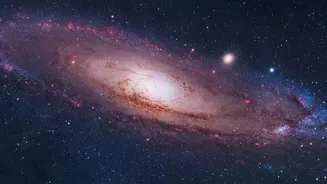
The Andromeda galaxy, also known as M31, is the closest major galaxy to our own Milky Way. Located 2.5 million light-years away, it's so close that it's visible to the naked eye as a faint smudge in a dark night sky. Because of its proximity, Andromeda serves
as a perfect cosmic laboratory. By studying it, astronomers can get an outside-in view of a large spiral galaxy that's similar in many ways to our own. Understanding its life story—how it formed, grew, and is evolving—provides invaluable clues about the past and future of the Milky Way.
Hubble's Unprecedented View
To piece together Andromeda's history, astronomers turned to the Hubble Space Telescope. Combining data from two massive surveys, the Panchromatic Hubble Andromeda Treasury (PHAT) and its southern counterpart (PHAST), researchers mapped about two-thirds of the galaxy's sprawling disk. These surveys allowed them to resolve about 200 million individual stars, creating an incredibly detailed stellar census. By analyzing the color and brightness of these stars—young, massive stars burn hot and blue, while older, smaller stars are cooler and redder—scientists can create a 'fossil record' of star birth over time.
A Galaxy Winding Down
The study revealed a clear and dramatic trend: Andromeda is a galaxy in decline. While it experienced a major burst of star formation about two billion years ago, likely from a galactic merger, its productivity has been slowing ever since. The new research shows that over the last 500 million years, this slowdown has been steady. More surprisingly, the rate of star birth has dropped off a cliff in the last 40 million years. Five hundred million years ago, Andromeda was creating stars at a rate of about one solar mass per year; today, that rate has plummeted to just one-fifth of a solar mass per year.
Explaining the Slowdown
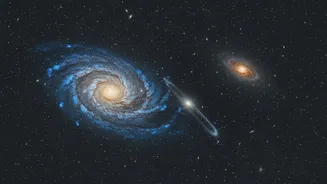
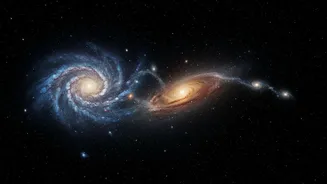
So what's causing Andromeda to run out of steam? The decline isn't happening uniformly across the galaxy. Most of the recent star-making activity is concentrated in a prominent ring about 32,000 light-years from the galactic center. As the fuel in this hyperactive ring gets used up, its fading activity drags down the galaxy's overall average. Astronomers also have a likely suspect for some of this disruption: Andromeda's small companion galaxy, M32. The region of Andromeda closest to M32 shows signs of decreased star formation beginning about 60 million years ago, hinting that gravitational interactions between the two galaxies may be interfering with the gas clouds needed to form new stars. While it's not definitive proof, M32 is considered the 'most likely suspect' for bullying its larger neighbor.
Lessons for the Milky Way
Studying Andromeda's middle-aged slowdown provides a fascinating glimpse into a possible future for our own galaxy. By reading the fossil record of its stars, we are learning about the complex lifecycle of galaxies like ours. The detailed history, made possible by Hubble, shows that galaxy evolution is not a simple, steady process but is shaped by dramatic events like mergers and quieter, long-term interactions with neighbors. These findings help refine our models of how all spiral galaxies evolve, providing a richer context for understanding our place in the cosmos and what lies ahead for the Milky Way, billions of years from now.