


Our Hostile, Yet Familiar, Neighbour
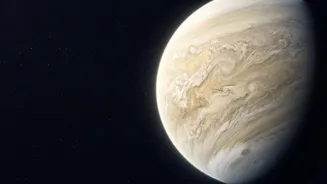
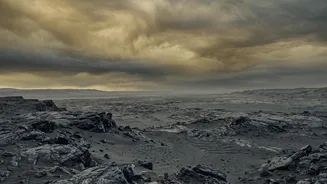
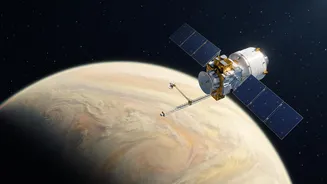
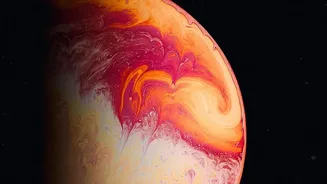
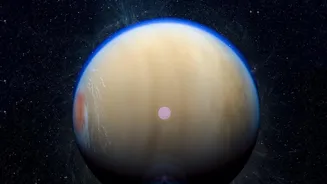
Venus is a planet of contradictions. It's the closest planet to Earth in both distance and size, yet it couldn't be more different. Its surface is a scorching landscape with temperatures hot enough to melt lead and an atmospheric pressure over 90 times
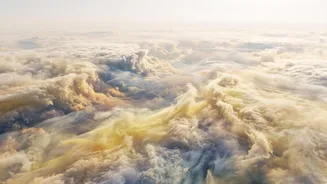
that of Earth's. Shrouding this inhospitable world is a thick, permanent blanket of clouds. For decades, scientists have known these are not fluffy water clouds like our own, but are composed of droplets of highly concentrated sulfuric acid, one of the most corrosive substances known. This toxic atmosphere has long been considered a primary reason why Venus is a planetary dead end, a world where the chemistry of life as we know it would be torn apart instantly.
A Temperate Haven in the Clouds?
Despite the brutal conditions on the ground, scientists have long speculated about a tantalizing possibility high above the surface. In a narrow band of the atmosphere, between roughly 48 and 60 kilometres up, the environment is surprisingly temperate. Temperatures and pressures in this cloud layer are much more Earth-like, leading some to wonder if it could be a potential refuge for life. If life ever began on Venus when it may have had oceans billions of years ago, this atmospheric layer is the only place it could have retreated to and survived. The main problem has always been the chemistry. How could any form of life, which relies on complex molecules like proteins and DNA, endure being suspended in droplets of nearly pure sulfuric acid?.
A Surprising Chemical Discovery
A new study from researchers at the Massachusetts Institute of Technology (MIT) has provided a startling answer to that question. Published in early September 2026, the research shows that peptides—which are short chains of amino acids, the fundamental building blocks of proteins—can survive in concentrated sulfuric acid. The scientists found that not only do these crucial molecules remain stable, but they also fold themselves into well-defined, three-dimensional structures. This is a critical discovery, because a molecule's shape determines its function. The finding challenges the long-held assumption that Venus's clouds would automatically shred the complex chemistry needed for biology.
How is Survival Possible?
The key to this unexpected stability lies in a chemical twist. Using a technique called nuclear magnetic resonance spectroscopy, the MIT team observed the peptides in a solution of 98% sulfuric acid. They found that the molecules remained intact for weeks. The reason is that the extreme concentration of acid means there is very little water available. On Earth, the primary way such molecules are broken down is through hydrolysis, a reaction with water. By removing water from the equation, the acid inadvertently preserves the peptides. This suggests that the building blocks for life, which are regularly delivered to Venus by meteorites, might not be destroyed on contact but could persist within the acidic cloud droplets.
Redefining the Search for Life
While this research does not prove that life exists on Venus, it fundamentally alters the landscape for astrobiologists. For years, the search for extraterrestrial life has been guided by the principle of following the water. This new finding suggests that the ingredients for life might be stable in very different kinds of liquid environments. Sara Seager, an MIT planetary scientist and a co-author of the study, argues that these results expand the range of planetary environments worth investigating. It opens up the possibility that planets we've written off as hostile, like Venus, might harbor a type of chemistry complex enough to support biology. This idea gained momentum after the controversial 2020 report of phosphine gas in Venus's atmosphere, a molecule that is difficult to explain without a biological source.