




Our Magnificent Neighbour
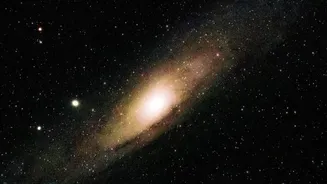
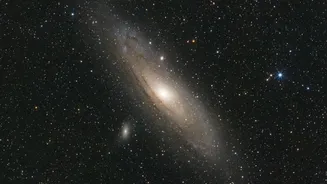
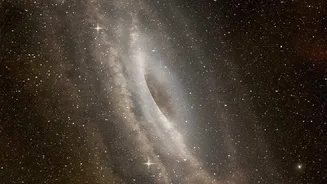
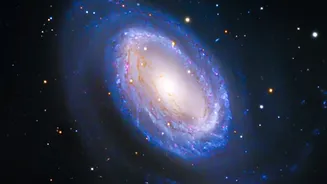
At just 2.5 million light-years away, the Andromeda galaxy, or M31, is the closest major spiral galaxy to our own Milky Way. It’s so close and large that on a clear, dark night, you can spot it with the naked eye as a faint, fuzzy smudge in the sky. For
astronomers, Andromeda is more than just a pretty sight; it’s a crucial natural laboratory. Because we are inside the Milky Way, it's impossible for us to get a bird's-eye view of our own galaxy. Andromeda offers the next best thing: a full, external view of a spiral galaxy similar in size to our own, allowing us to study its structure and history in breathtaking detail.
Hubble's Galactic Census
To unlock Andromeda's secrets, astronomers turned to the Hubble Space Telescope. Through two massive surveys—the Panchromatic Hubble Andromeda Treasury (PHAT) and the Panchromatic Hubble Andromeda Southern Treasury (PHAST)—the telescope meticulously mapped about two-thirds of the galaxy's sprawling disk. These projects weren't just taking a simple picture; they conducted a stellar census, resolving and measuring around 200 million individual stars. By analysing the colour of these stars—young, massive stars burn hot and blue, while older stars are cooler and redder—scientists can create a 'fossil record' of the galaxy's history, revealing when and where stars have been born over millions of years.
A Galaxy Winding Down
The study's most striking discovery is that Andromeda's era of prolific star birth is fading. While the galaxy experienced a major boom in star formation about two billion years ago, likely from a past merger, its production has been steadily declining ever since. New research shows that 500 million years ago, Andromeda was creating stars at a rate of about one solar mass per year—similar to the current rate in our Milky Way. However, this rate has plummeted, dropping by half by 40 million years ago, and is now down to just one-fifth of a solar mass per year. The galaxy isn’t running out of the necessary gas and dust; it appears to be taking a natural breather after a more active past.
The Tale of a Fading Ring
This slowdown isn't happening uniformly across the galaxy. The data reveals that much of the recent star-making activity has been concentrated in a prominent ring about 32,000 light-years from Andromeda's core. This ring has been the galaxy's primary stellar nursery for hundreds of millions of years, but its activity is now waning, which is the main driver of the galaxy's overall decline in star formation. In contrast, the central bulge of the galaxy is much older and quieter, dominated by aging red stars. This suggests that a galaxy's evolution is a complex story that varies dramatically from one region to another.
A Glimpse into Our Cosmic Future?
Studying Andromeda’s life cycle helps us understand the path that all large spiral galaxies, including our own, might take. The findings show Andromeda as a galaxy in transition, slowly evolving from a vibrant star-forming spiral into a more quiescent one. Some researchers also suspect that interactions with its small companion galaxy, M32, may have influenced its star-forming activity in certain areas. As Andromeda and the Milky Way are on a collision course set to occur in about 4.5 billion years, understanding our neighbour's current state and history is like reading a chapter from our own distant future. These studies provide critical insights into the grand, cosmic dance of galactic evolution.