


A Puzzling Pattern on the Red Planet
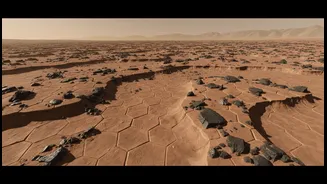
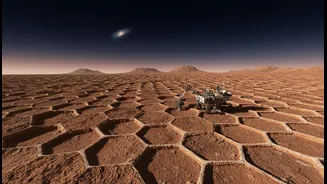
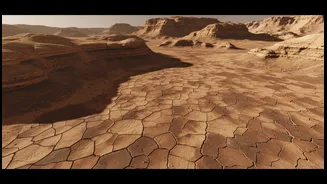
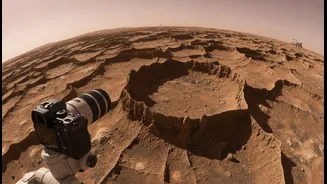
Across the vast, cold plains of Mars, especially in its mid-to-high latitudes, scientists have observed a curious and widespread phenomenon: the ground is fractured into immense polygonal shapes. Revealed in stunning detail by orbiters like NASA's Mars Reconnaissance
Orbiter, these are not small, superficial cracks. Instead, they form massive, interconnected networks of troughs that carve the landscape into geometric patterns often tens of meters across. For years, these features have been a subject of intense study, resembling landscapes found in some of the coldest regions on our own planet. Their scale and structure suggest they were not formed by simple drying mud, but by a much more powerful and persistent geological process tied directly to the planet's climate history.
A Telltale Sign from Earth's Arctic
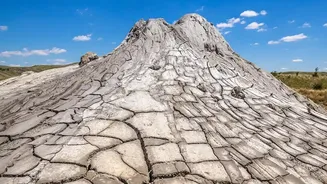
The key to understanding Martian polygons lies in Earth's polar regions. Here, similar patterns form in permafrost—ground that remains frozen for at least two consecutive years. This process is known as thermal contraction cracking. During the deep cold of winter, the ice-rich soil contracts intensely, causing it to fracture. In the warmer season, the cracks can be filled with meltwater or sand, which then freezes, forming an ice wedge. Over thousands of years of seasonal freezing and thawing, these wedges grow and push the surrounding soil apart, creating a distinct network of polygon-shaped ground. The striking similarity between these terrestrial features and those on Mars provides strong evidence that the Red Planet once experienced similar cyclical temperature shifts in areas with abundant subsurface ice or groundwater.
Digging Deeper with Radar
While orbital images gave us a surface-level view, recent data has provided a look deep beneath the Martian dust. China's Zhurong rover, exploring the Utopia Planitia region, used ground-penetrating radar to make a remarkable discovery: giant polygonal structures buried more than 35 meters (115 feet) below the surface. This was a game-changer. Finding these patterns is one thing, but finding them buried under thick layers of sediment indicates they are ancient relics from a bygone era. Furthermore, these buried polygons were found near Mars' equator, a region long thought to have been too warm for the freeze-thaw cycles required to create them.
Rewriting the Martian Climate Story
The discovery of polar-style geological features at the Martian equator has profound implications. It suggests that billions of years ago, Mars' climate was drastically different. Scientists now theorize that the planet may have had a much greater axial tilt, causing its equatorial regions to experience cold, polar-like conditions. This would have created a scenario where ice could form and persist far from the current poles, driving the freeze-thaw cycles needed to create these massive polygons. The subsequent burial of these features points to a later, dramatic shift in climate, where wind-blown sand and dust covered these ancient terrains, preserving them as a record of a stark environmental transition. It paints a picture of a world that didn't just dry up, but went through extreme climatic swings.
The Ultimate Search for Habitability
Beyond geology, these findings are crucial for the search for life. The existence of widespread, persistent groundwater—even if seasonally frozen—is a critical ingredient for habitability. Environments with cyclical liquid water and stable subsurface conditions could have provided a sanctuary for microbial life to emerge and survive. Discoveries made by rovers like Curiosity and Perseverance have already confirmed that ancient Mars had complex organic molecules and long-lasting water systems. The polygon fields act as a large-scale map, pointing scientists toward regions where groundwater was once abundant. By studying these ancient, water-carved landscapes, future missions can better identify prime locations to search for the fossilized chemical signatures that might finally answer whether we have ever been alone in the solar system.