






New Capabilities in Chennai
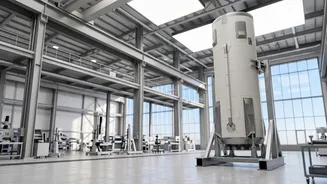
In a significant development for India's private space sector, Agnikul Cosmos has inaugurated two advanced facilities at its Chennai campus. The Stage Testing & Inspection Facility (STIF) and the Pressurant Tank Realisation, Over-wrapping and Outfitting
Facility (PROOF) were opened in early September 2026. STIF is engineered to test complete, integrated rocket stages in conditions that mimic an actual flight, a crucial step for validating reusable hardware. It also allows for post-flight inspection and requalification of recovered stages, building a cycle of test-fly-recover-requalify that is fundamental to reusability. The PROOF facility brings the production of high-pressure composite vessels in-house, reducing reliance on external suppliers and speeding up development. Together, these facilities give Agnikul end-to-end control over the entire lifecycle of its rocket stages, from manufacturing with its signature 3D-printing technology to testing and preparation for future flights.
The Reusability Revolution
The core debate in the space launch industry today revolves around reusability. For decades, rockets were expendable, with each multi-million-dollar vehicle being discarded after a single use. This made space access prohibitively expensive. The paradigm shifted when companies like SpaceX, with its Falcon 9 rocket, proved that recovering and reusing the most expensive part of the rocket—the first stage booster—was not only possible but economically transformative. By landing boosters vertically after a mission, refurbishing them, and flying them again, the cost of reaching orbit has been drastically reduced. This has been compared to the shift from disposable to reusable aircraft, which revolutionised air travel. The promise of reusability is a higher launch frequency at a lower cost, opening up space for satellite constellations, scientific missions, and new commercial ventures that were previously unfeasible.
The High-Stakes Economic Equation
While the benefits are clear, the path to reusability is incredibly challenging and capital-intensive. Developing the technology for controlled descent, landing, and refurbishment requires massive upfront investment in research and infrastructure. The process of inspecting and requalifying a flown rocket stage for another flight is complex and costly in itself. Critics have long argued that the savings from reusability only materialise after a very high flight rate is achieved, making it a risky bet. However, the success of pioneers in the field has proven the model works, with some reused boosters bringing launch costs down by 40-60% compared to expendable rockets. This economic advantage is forcing the entire industry to adapt, creating a clear divide between legacy players and the new generation of companies building their business models around reusability from day one.
India's Ambitions Take Flight
Agnikul's latest move is a crucial piece of India's larger space ambition. While the Indian Space Research Organisation (ISRO) has its own long-running Reusable Launch Vehicle (RLV) program, named 'Pushpak', the emergence of private players like Agnikul is accelerating progress. ISRO has focused on a winged, shuttle-like vehicle, conducting successful landing experiments. Startups, on the other hand, are often pursuing the propulsive landing model pioneered by SpaceX. The Indian government has actively encouraged this private participation through policy changes and organisations like IN-SPACe, which facilitates access to ISRO's facilities and expertise. Agnikul, an IIT-Madras incubated startup, has already achieved several firsts, including launching from a private launchpad and successfully testing its unique single-piece 3D-printed rocket engine. This new facility signals that the company is serious about tackling the next great challenge: making its rockets fly not just once, but again and again.