







A Habitable Zone World
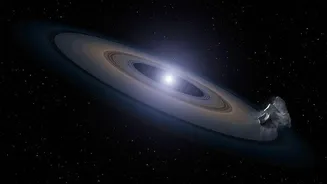
The planet in question is LHS 1140 b, a 'super-Earth' located approximately 48 light-years away. Discovered in 2017, it's about 70% larger than Earth and has more than five times its mass, suggesting a dense, rocky composition. It orbits a red dwarf star,
which is smaller and cooler than our sun. Crucially, LHS 1140 b resides within its star’s 'habitable zone' — the orbital range where conditions might be just right for liquid water to exist on the surface, a key ingredient for life as we know it. For years, finding a rocky planet in this zone with a confirmed atmosphere has been a primary goal for astronomers.
Catching an Atmosphere in the Act
So how did scientists 'see' an atmosphere from nearly 50 light-years away? A team led by researcher Collin Cherubim used the Magellan Clay Telescope in Chile to observe the planet as it passed in front of its star, an event known as a transit. Using an instrument called a spectrograph, they analysed the starlight filtering through the very edge of the planet. These observations, made in 2024, revealed the distinct chemical signature of helium gas being pulled away from the planet's upper atmosphere. This escaping gas is the first direct, robust evidence of an atmosphere on a rocky world in the habitable zone.
Why Is the Helium Escaping?
The planet's atmosphere isn't just sitting there; it's actively leaking into space. This process, known as atmospheric escape, is driven by the intense high-energy radiation from the planet's host star. Red dwarfs are known for being volatile, especially in their youth, capable of stripping atmospheres from nearby planets. The fact that LHS 1140 b, which is estimated to be over three billion years old, has retained any atmosphere at all is remarkable. It suggests that some rocky worlds can withstand this stellar bombardment for billions of years. The discovery of helium, a relatively light element, implies there may be a substantial reservoir of heavier gases like nitrogen or carbon dioxide closer to the surface.
A Glimpse Into Planetary Pasts
This discovery is more than just a confirmation of one planet's atmosphere; it provides a vital data point for understanding planetary evolution. Some scientists believe that a young Earth may have had a primordial atmosphere rich in hydrogen and helium, which it later lost. Observing this process on LHS 1140 b is like looking back in time, offering clues about how planets like Earth and Mars formed and why their atmospheres diverged so dramatically. It challenges old assumptions and suggests that a new class of 'helium worlds' may exist. Interestingly, when the team observed the planet again in 2025, the helium signal was absent, suggesting the rate of atmospheric escape can vary over time, a discovery that opens up new questions for future study.