






An Ocean of Molten Iron
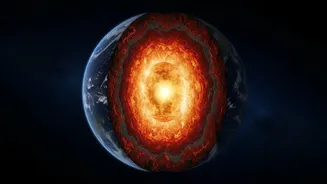
Imagine a sphere of liquid metal, hotter than the surface of the sun, swirling thousands of kilometres below you. This is Earth's outer core. It’s a turbulent world, roughly 2,200 kilometres thick, composed primarily of molten iron and nickel. This superheated,
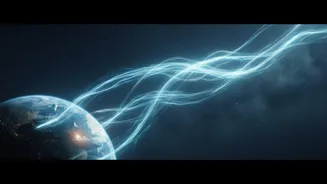
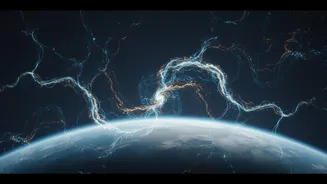
electrically conducting fluid is in constant motion, acting like a colossal dynamo. As it moves, it generates powerful electric currents, which in turn produce our planet's magnetic field. This field, known as the magnetosphere, extends far into space, shielding us from harmful cosmic radiation and charged particles from the sun. Without it, life as we know it would not be possible. For centuries, our understanding of this deep engine was limited. But now, we have eyes in the sky that can peer into this hidden realm.
Satellites as Our Planet's Stethoscope
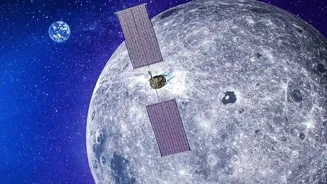
So, how can a satellite orbiting hundreds of kilometres above the surface tell us anything about the core? The answer lies in magnetism. While we can't see the core directly, we can measure its effects with extreme precision. This is the job of missions like the European Space Agency's (ESA) Swarm constellation—a trio of identical satellites launched in 2013. These spacecraft are equipped with highly sensitive magnetometers that measure the strength, direction, and variations of the magnetic field all over the globe. By flying in a specific formation, with two satellites orbiting side-by-side and a third at a higher altitude, Swarm can differentiate between magnetic signals from the core and those from other sources like the Earth's crust or oceans. Think of it like a planetary-scale stethoscope, listening for the subtle rumbles and shifts deep within. These tiny fluctuations in the magnetic field are our clues to the chaotic dance of the molten iron below.
The Great Pacific Reversal
For a long time, scientists inferred that the flow in the outer core was generally moving westward. But by analysing decades of satellite and ground data, they discovered something astonishing. Around 2010, a huge region of this molten river deep beneath the Pacific Ocean did an about-face. What was once a weak westward flow suddenly became a strong eastward current. This event, dubbed the Pacific core-flow reversal, challenged the long-held assumption that the core's circulation was a relatively stable, slow-moving system. Instead, it revealed a far more dynamic and volatile environment, where dramatic changes can happen within just a decade. The discovery was made by combining data from multiple satellite missions—including Swarm, CryoSat, CHAMP, and Ørsted—with ground-based observations to piece together a timeline of this unexpected change.
Decoding the Clues: Jerks and Waves
This reversal didn't happen in a vacuum. Scientists believe it's linked to other mysterious phenomena called "geomagnetic jerks." These are sudden, abrupt changes in the magnetic field's acceleration that are observed irregularly, on average about once a decade. Numerical simulations suggest these jerks could be caused by powerful hydromagnetic waves, known as Alfvén waves, that are unleashed from deep within the core. These waves, possibly triggered by buoyant blobs of molten material rising towards the core's surface, race outwards and create sharp changes in the core's flow. The Pacific reversal, which occurred around the same time as a notable geomagnetic jerk in 2017, seems to be a surface-level manifestation of these deeper, more powerful dynamics. It suggests a complex interplay between different layers of the core, a connection that scientists are only just beginning to understand.
Why Does a Reversal 3,000 km Down Matter?
A change in flow deep within the Earth might seem abstract, but it has significant implications. Understanding the core's behaviour is crucial for predicting the future of our magnetic shield. The field is not static; its strength is currently decreasing at a rate of about 5% per century, and areas of profound weakness like the South Atlantic Anomaly are expanding. While the recent Pacific reversal is a localised event and not a sign of an impending global pole flip, studying it provides vital data for our models. It shows that the core is far more turbulent and capable of rapid change than previously thought. According to researchers, the eastward flow has already started to weaken since 2020, suggesting this reversal might be part of a repeating cycle. Continued monitoring of these deep-Earth dramas is essential to understanding the long-term stability of the planetary systems that protect us all.