



The Challenge of Finding Your Way
Until now, navigating in space has been a bit like a long-distance phone call. Spacecraft on or around the Moon have had to constantly 'talk' to Earth, relying on NASA's Deep Space Network (DSN) to figure out where they are. This system sends signals
from massive radio antennas on Earth to the spacecraft and back. While incredibly precise, this method has its limits. The DSN is a shared resource, supporting dozens of missions across the solar system, which creates a bottleneck. This reliance on Earth-based tracking is costly, time-consuming, and means a spacecraft can't make quick, independent decisions, which is risky during critical moments like landing.
A GPS for the Moon
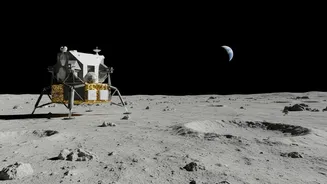
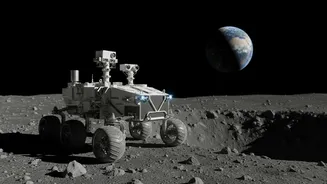
To solve this, NASA is championing a new approach: autonomous navigation. The idea is to create a system that allows spacecraft to determine their own position without constantly phoning home. One key piece of this puzzle is the Lunar Node-1 (LN-1) payload. Developed at NASA's Marshall Space Flight Center, LN-1 is a shoebox-sized radio beacon designed to be the first 'lighthouse' in a future lunar navigation network. It was successfully tested on Intuitive Machines' IM-1 mission, which landed on the Moon in early 2024, demonstrating that such a system is viable. The goal is to build a network of these beacons, creating a framework similar to Earth's Global Positioning System (GPS).
How Autonomous Navigation Works
There are several clever ways spacecraft can navigate on their own. One method involves using the faint signals from Earth's existing GPS and Galileo satellites. Specialized high-sensitivity receivers, like NASA's NavCube3-mini, can pick up these signals far from their intended range, providing a position fix. Another approach is optical navigation, where a spacecraft uses cameras to take pictures of the lunar surface. Advanced software then identifies craters and other landmarks, comparing them to a pre-loaded map to calculate its location. The LN-1 experiment adds another layer, creating a local network where spacecraft can communicate with each other and with surface beacons to triangulate their positions, much like how your phone uses multiple cell towers to improve its location accuracy.
The Benefits of Self-Reliance
The shift to autonomous navigation brings huge advantages. By reducing the dependence on the oversubscribed Deep Space Network, missions become cheaper and more scalable. Instead of a few missions competing for tracking time, dozens or even hundreds of spacecraft could operate simultaneously. This boosts safety, especially for crewed missions. Astronauts could navigate in real-time without communication delays, and landers could make instant adjustments during tricky descents. It opens up operations on the far side of the Moon, which is out of direct line-of-sight with Earth. This autonomy is fundamental to establishing a sustainable lunar presence, from scientific outposts to future commercial activities like mining.
Building the Lunar Internet
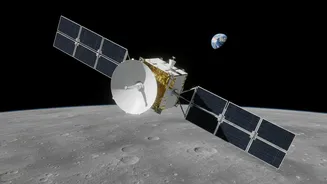
This technology is a cornerstone of NASA's broader LunaNet architecture, an ambitious plan to create a dedicated communications and navigation network for the Moon. Think of it as an 'internet' for our celestial neighbour, providing not just navigation but also connectivity and even a search and rescue system (LunaSAR). Private companies are also stepping in. Lockheed Martin, for example, has launched a subsidiary called Crescent Space Services to deploy its own network of lunar communication and navigation satellites. This growing infrastructure is vital for the success of the Artemis program, which aims to return humans to the Moon and build a permanent base, an effort in which India and other international partners are increasingly involved.