







A Trillion-Dollar Tech Boom
The global technology industry is in the midst of an unprecedented spending spree, with total IT expenditure forecast to hit $6.37 trillion in 2026, a staggering 14.2% jump from the previous year. While sectors like software and services are growing,
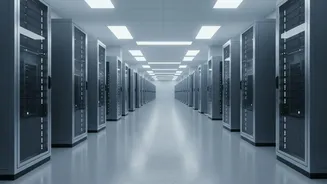
the single biggest driver of this surge is the explosive investment in data centre systems. This segment alone is projected to grow by an astonishing 62.5% in 2026, reaching $822 billion. This isn't just routine upgrading; it’s what one market analyst firm calls “the largest infrastructure project ever attempted by humanity,” and it's almost entirely driven by the voracious computational demands of artificial intelligence.
Why Standard Data Centres Can't Handle AI
Today's advanced AI, particularly generative models that create text, images, and code, requires a completely different kind of engine than traditional computing. Standard data centres, built around Central Processing Units (CPUs), are designed for a wide variety of general tasks. AI workloads, however, involve processing immense datasets through complex calculations in parallel. This requires specialized hardware, primarily Graphics Processing Units (GPUs), which can handle thousands of simultaneous computations. These powerful chips consume enormous amounts of energy and generate intense heat, rendering the design of older data centres obsolete. AI-focused facilities are purpose-built with high-density power grids, advanced liquid cooling systems, and ultra-fast networking to prevent bottlenecks and meltdowns.
The Soaring Cost of AI's New Home
Building an AI-ready data centre is a far more expensive proposition than a traditional one. The industry has shifted from measuring cost by square foot to a new benchmark: cost per megawatt (MW) of power. While a standard data centre might cost between $8 million and $12 million per MW to construct, an AI-optimized facility can easily exceed $20 million per MW. The building itself is only part of the equation. Electrical systems can account for nearly half the construction budget, and the specialized IT hardware—the servers, high-speed storage, and tens of thousands of GPUs—can cost billions more for a single large-scale facility. This premium is driving the dramatic increase in overall spending.
The Hyperscaler Arms Race
The primary players in this infrastructure arms race are the 'hyperscalers'—the giants of cloud computing like Amazon (AWS), Microsoft (Azure), and Google (Google Cloud). These companies are pouring hundreds of billions of dollars into building out their AI capabilities to stay competitive and meet surging demand from enterprise clients. In 2026 alone, the top five hyperscalers are expected to spend over $600 billion on capital expenditures, with the vast majority earmarked for AI infrastructure. This investment is a massive bet that the future of business services—from software development to customer support and scientific research—will be delivered via their AI-powered cloud platforms.
Challenges on the Horizon
This historic build-out is not without significant hurdles. The immense power required for these facilities is placing a strain on electrical grids in many regions, creating a new bottleneck in development. The demand for specialized components, particularly advanced GPUs and high-bandwidth memory, has led to supply chain constraints and rising prices across the board. Furthermore, environmental concerns are growing over the massive electricity and water consumption associated with these power-hungry centres. While the investment continues at a breakneck pace, questions remain about the long-term return on investment, as many companies are still in the early stages of generating significant revenue from their AI deployments.