








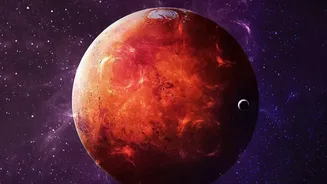
A Major Milestone for Astronomy
In a discovery that feels like a chapter from a science fiction novel, astronomers have announced the first confirmed atmosphere around a rocky planet located in its star's habitable zone. The planet, a “super-Earth” named LHS 1140 b, is located about
49 light-years away and has long been a tantalizing target for scientists. Published in the journal Science, the new research provides the strongest evidence yet that planets similar to our own can retain the gassy envelopes essential for regulating temperature and shielding potential life from harsh cosmic radiation. This isn't just another planet; it's a turning point in our search for potentially habitable worlds beyond our solar system.
Meet LHS 1140 b
First discovered in 2017, LHS 1140 b is about 1.7 times the size of Earth and roughly 5.6 times as massive. This categorizes it as a super-Earth, a class of planet not found in our solar system. It orbits a small, cool red dwarf star every 25 days. Crucially, it orbits within the star’s “habitable zone.” This is often called the “Goldilocks zone,” a region where the temperature is just right for liquid water to potentially exist on a planet's surface — not too hot that it boils away, and not too cold that it freezes solid. For years, finding a rocky planet in this zone was one challenge; proving it had an atmosphere was a much harder one.
How to See an Invisible Atmosphere
So, how do you detect something as thin as air from nearly 50 light-years away? The team used a clever technique called transmission spectroscopy. As LHS 1140 b passed in front of its star from our point of view—an event called a transit—a tiny fraction of the starlight filtered through the planet’s atmosphere. Using the WINERED spectrograph on the Magellan Clay Telescope in Chile, astronomers could analyse this light. Chemicals in an atmosphere absorb light at specific, unique wavelengths, creating a sort of chemical barcode. In this case, the telescope picked up the unmistakable signature of helium gas escaping from the planet's upper atmosphere, confirming its existence.
What Does This Atmosphere Tell Us?
The detection of helium is a monumental proof of concept, but it's just the beginning. Helium itself can't support life as we know it, but its presence proves the planet has enough gravity and resilience to hold onto an atmosphere for billions of years, despite being bombarded by radiation from its red dwarf star. This was a major question for planets orbiting these common, but often volatile, stars. Scientists believe that heavier gases, like nitrogen, carbon dioxide, or even water vapour, could be trapped in the lower, denser parts of the atmosphere, closer to the surface. This new study shows that rocky worlds around red dwarfs are not necessarily barren and airless, dramatically widening the search for habitable environments.
Not Habitable, But a Pathway to It
It is crucial to be clear: scientists have not found life on LHS 1140 b, nor have they confirmed it is habitable. The surface temperature is estimated to be chilly, around -7°C, though a strong greenhouse effect could warm it significantly. Furthermore, some models suggest it could be a 'water world' with deep oceans, rather than a planet with continents like Earth. But this discovery is less about this one planet and more about what it represents. It validates that the essential ingredients for habitability—a rocky surface, the right temperature, and a protective atmosphere—can all be found in one place outside our solar system.