


A Star's Final Roar
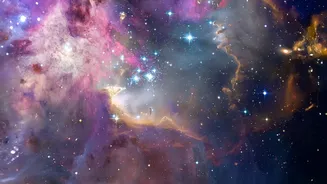
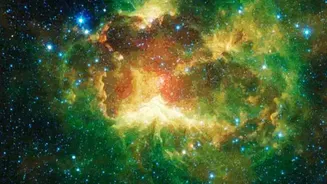
Located about 5,000 light-years away, the Lion Nebula, officially known as NGC 2392, is what astronomers call a planetary nebula. Despite the name, it has nothing to do with planets. Instead, it is the beautiful, expanding shell of gas and dust shed by
a star similar to our own Sun as it reached the end of its life. At the very centre of this celestial artwork sits the star's hot, dense core, known as a white dwarf. This stellar remnant is incredibly hot, and its intense radiation is what illuminates and shapes the surrounding material, creating the intricate structures that give the nebula its name.
Seeing the Unseen Dust
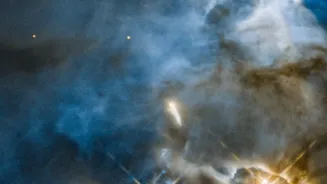
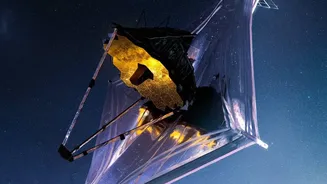
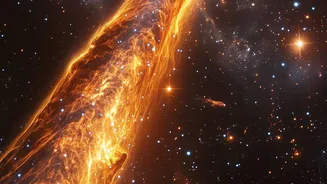
While the Hubble Space Telescope gave us remarkable views of the Lion Nebula in the past, the James Webb Space Telescope’s powerful infrared vision has peeled back another layer of mystery. This new image, a composite from Webb’s Near-Infrared Camera (NIRCam) and Mid-Infrared Instrument (MIRI), provides a much clearer look at the nebula's complex structure. The most striking feature highlighted by Webb is the delicate, comet-like clumps of dust within the nebula's outer 'mane'. These are dense pockets of material that have somehow survived the blistering radiation from the central star that is destroying other, less dense dust around them.
Cosmic Recycling in Action
These surviving dust clumps are more than just pretty features; they are a key part of a cosmic story. The material being blasted away from the dying star is not simply lost. It is being recycled back into the interstellar medium, the vast expanse of gas and dust between stars. This material includes heavier elements forged inside the star during its lifetime. By protecting the material that lies behind them, these durable dust clumps act like shields, preserving the ingredients for future cosmic construction. Eventually, this ejected material will mix with other clouds, cool down, and one day form new stars and planetary systems. In a way, we are looking at a preview of our own Sun's distant future and the origins of the raw materials for the next generation of stars.
A Fleeting Moment in Time
The incredible structures we see in the Lion Nebula are not permanent. The nebula has been forming and changing for several thousand years as the gas and dust travel away from the central white dwarf. Astronomers estimate that the entire structure will continue to expand and will eventually disperse into space in about 10,000 years — a relatively short period on an astronomical timescale. Webb's observation captures a magnificent, yet fleeting, moment in the life cycle of a star. Each new image from the telescope helps scientists better understand the complex interplay between stellar radiation and the dust and gas that stars shed, a fundamental process that shapes the evolution of galaxies.