



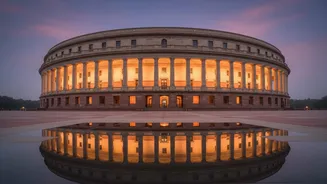
Freedom at Midnight, Dominion at Dawn
When Jawaharlal Nehru delivered his iconic 'Tryst with Destiny' speech on the eve of August 15, 1947, India awoke to a new dawn of freedom. The tricolour was hoisted, and celebrations erupted across the nation. Yet, legally, India's journey to complete
self-governance was not yet finished. Under the Indian Independence Act of 1947, the country became the Dominion of India. This meant that while India was independent and had its own Prime Minister, the head of state was still the British monarch, King George VI. He was represented in India by a Governor-General. Lord Mountbatten, the last Viceroy, became the first Governor-General of independent India, later succeeded by C. Rajagopalachari, the only Indian to hold the post. It was a period of newfound sovereignty but within a familiar constitutional framework, a bridge between the colonial past and a republican future.
The Great Task: Writing a Nation's Future
While the new government tackled the immediate and immense challenges of Partition and nation-building, another monumental task was underway. The Constituent Assembly, which first met in December 1946, was diligently at work, drafting the Constitution of India. This body, composed of elected representatives from across the country, became the sovereign legislature of the Dominion. For two years, 11 months, and 18 days, its members debated, deliberated, and decided on every aspect of the new nation's legal and social framework. Led by the brilliant Dr. B.R. Ambedkar as the chairman of the Drafting Committee, they studied the constitutions of other nations but ultimately sought to create a document that was uniquely Indian, addressing its vast diversity and deep-seated social issues. This period was not a pause, but a flurry of foundational activity.
Forging the Symbols of a New Era
A republic is defined not just by its laws, but by its symbols. While the tricolour was adopted as the national flag on July 22, 1947, just before independence, other key symbols were only finalised with the birth of the Republic. The most significant of these is the National Emblem. The majestic Lion Capital of Ashoka from Sarnath was officially adopted as the emblem on January 26, 1950. This choice was deeply symbolic, linking the new, modern India to the ancient Mauryan ideals of peace and righteous rule. Similarly, while 'Jana Gana Mana' and 'Vande Mataram' were well-known patriotic songs, they were officially adopted as the national anthem and national song respectively on January 24, 1950, just two days before the constitution came into effect.
January 26, 1950: The Republic is Born
The work of the Constituent Assembly culminated on November 26, 1949, when the Constitution of India was formally adopted. However, its provisions came into force two months later, on a date of profound historical significance. January 26th was chosen to honour the Purna Swaraj (Complete Independence) declaration made by the Indian National Congress in 1930. On that day in 1950, India was officially proclaimed a sovereign, socialist, secular, and democratic republic. The office of the Governor-General was abolished, and Dr. Rajendra Prasad was sworn in as the first President of India, the new constitutional head of state. The Dominion of India ceased to exist, replaced by the Republic of India—a nation finally and fully its own master.