






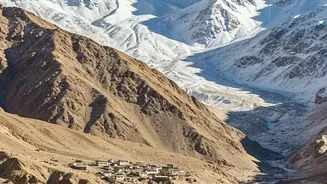
The 2013 Kedarnath Floods
In June 2013, Uttarakhand witnessed a tragedy of horrifying scale. Unprecedented rainfall, nearly 375% more than the benchmark for the period, led to a deadly combination of flash floods and landslides. The disaster was severely amplified by a glacial
lake outburst flood (GLOF) from Chorabari Lake, which sits above Kedarnath town. The ensuing deluge down the Mandakini river swept away entire settlements, with the pilgrimage hub of Kedarnath valley being the worst hit. Official figures stated over 5,700 people were presumed dead, with thousands more missing and over a hundred thousand evacuated. The event exposed the devastating consequences of unchecked construction and inadequate disaster planning in a geologically sensitive zone.
The 2015 Nepal Earthquake
On April 25, 2015, a magnitude 7.8 earthquake struck Nepal, with its epicentre northwest of Kathmandu. It was the country's worst natural disaster in over 80 years, claiming approximately 9,000 lives, injuring nearly 22,000, and affecting over 8 million people—more than a quarter of Nepal's population. The quake flattened entire villages, destroyed over 600,000 structures, and caused an estimated $10 billion in damage. The primary shock also triggered catastrophic secondary disasters, including a massive avalanche on Mount Everest that killed at least 19 people and another in the Langtang valley where 250 were reported missing. This event highlighted the region's extreme seismic risk, lying on the collision zone of the Eurasian and Indo-Australian tectonic plates.
The 2021 Chamoli Flash Flood
On February 7, 2021, a torrent of water, rock, and debris charged down the Rishiganga and Dhauliganga river valleys in Uttarakhand's Chamoli district. The disaster claimed over 200 lives and completely obliterated the Rishiganga hydropower project, while severely damaging the larger Tapovan-Vishnugad plant. Initial reports suggested a glacial lake outburst, but detailed analysis later confirmed the cause was a colossal rock and ice avalanche from Ronti Peak. An estimated 27 million cubic metres of material collapsed, with the impact's energy melting the ice and generating the devastating slurry. The disaster was a brutal illustration of the cascading hazards present in the high mountains, where a single event like a landslide can trigger a deadly downstream flood, amplified by the presence of large-scale infrastructure.
The 2023 Joshimath Land Subsidence
The crisis in Joshimath was a slow-burn disaster that accelerated dramatically in early January 2023. The town, built on the debris of an ancient landslide, began sinking at an alarming rate. Within days, cracks appeared in hundreds of homes, roads, and buildings, forcing mass evacuations. Satellite data revealed that the town sank by 5.4 cm in just 12 days. Experts have long warned about the town's instability, a vulnerability made worse by unplanned urbanisation, the absence of a proper drainage system, and the toe-cutting erosion from rivers below. While not a single, violent event, the sinking of Joshimath exposed the grave risks of unsustainable development on fragile terrain, a problem prevalent across the Himalayan belt.
The 2023 Sikkim Glacial Flood
On October 4, 2023, a catastrophic Glacial Lake Outburst Flood (GLOF) was unleashed in Sikkim. The South Lhonak glacial lake, which had been rapidly expanding due to melting ice, breached its moraine dam. The trigger was a massive landslide plunging into the lake, generating a tsunami-like wave that broke through the dam. A wall of water equivalent to 20,000 Olympic swimming pools surged down the Teesta River valley, raising water levels by up to 20 feet. The flood destroyed the 1,200-megawatt Teesta-III Dam at Chungthang and caused widespread devastation downstream, resulting in dozens of deaths. The event was a textbook example of a climate change-driven disaster, highlighting the growing threat from over 300 potentially dangerous glacial lakes in the Indian Himalayas.
The 2023 Uttarakhand Tunnel Collapse
In November 2023, the vulnerability of Himalayan infrastructure was starkly revealed when a section of the under-construction Silkyara road tunnel in Uttarakhand collapsed, trapping 41 workers inside. While all the men were eventually rescued after a harrowing 17-day multi-agency operation, the incident drew intense scrutiny. The collapse highlighted the immense geological pressures and fragile rock conditions that make tunnelling and large-scale construction in the young, unstable Himalayas so perilous. Though the exact cause was not specified by authorities, it served as a powerful reminder that ambitious development projects can encounter severe, life-threatening challenges when pushed through such a geologically active and sensitive environment.
The 2026 Nepal-Tibet Border Flood
In late August 2026, a massive flash flood struck the Himalayan border areas of Nepal and Tibet after a huge mass of rock and ice collapsed, sending a devastating surge through multiple river systems. The event, which occurred without a significant rainfall or earthquake trigger, was so powerful it generated its own seismic signals. The flood caused catastrophic damage, destroying villages, bridges, and numerous hydropower projects. The Trishuli River swelled by up to nine metres in just 30 minutes, illustrating the incredible speed and force of such events. This disaster underscored the complex and interconnected nature of Himalayan hazards, where climate change is believed to be increasing the instability of glaciers and mountain slopes, leading to more frequent and unpredictable disasters with transboundary impacts.