







An Ocean World Shooting Samples Into Space
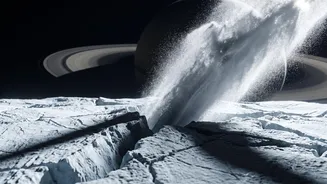
Enceladus might be small, only about 500 kilometres in diameter, but it punches far above its weight in astrobiological significance. Beneath a thick crust of ice lies a global ocean of liquid saltwater. What makes Enceladus particularly tantalizing is
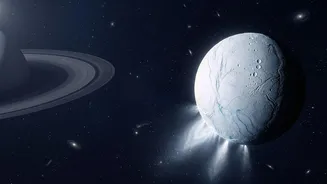
that it provides a way to sample this hidden ocean without ever drilling through the ice. Giant plumes of water vapour and ice grains erupt from cracks near the moon’s south pole, jetting hundreds of kilometres into space. These geysers, first analyzed by NASA’s Cassini spacecraft, offer a direct glimpse into the chemistry of the water below. The Cassini mission, which ended in 2017, discovered that these plumes contain a rich array of organic compounds, salts, methane, and molecular hydrogen — many of the foundational ingredients for life as we know it.
Finding the Final Ingredient
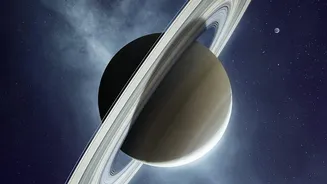
For life to exist, it needs a handful of key elements, often abbreviated as CHNOPS: carbon, hydrogen, nitrogen, oxygen, phosphorus, and sulfur. While Cassini’s data confirmed the presence of most of these, phosphorus remained stubbornly elusive. Phosphorus is non-negotiable for life on Earth; it forms the backbone of DNA and is crucial for creating cell membranes and energy-carrying molecules like ATP. Its apparent absence was a major question mark over Enceladus's potential habitability. However, subsequent analysis of Cassini data, combined with geochemical modelling, began to change the picture. In 2022, models predicted that phosphorus should be abundant, and in 2023, scientists confirmed its presence by directly detecting high concentrations of phosphates in the ice grains from Saturn's E ring, which is fed by Enceladus's plumes. This discovery satisfied one of the strictest requirements for a celestial body to be considered habitable.
Simulating an Alien Seafloor in the Lab
The latest evidence, published in late 2026, takes this a step further. Researchers at Freie Universität Berlin conducted a pair of groundbreaking lab studies to simulate the unique conditions on Enceladus. They recreated the high-pressure, alkaline environment of the moon's seafloor, where water is believed to interact with a rocky core through hydrothermal vents. In one experiment, they introduced a type of Earth microbe called a methanogen, which thrives near deep-sea vents and doesn't require oxygen. The microbe, Methanothermococcus okinawensis, not only survived but thrived, producing methane by using the hydrogen and carbon dioxide available in the simulated Enceladus environment. This doesn't prove life exists there, but it demonstrates that a known organism can survive and function under the moon's alien conditions.
Making the Search for Life Easier
The second recent study delivered more good news for future missions. Scientists investigated how the ocean water freezes and gets ejected into space. They found that as water droplets rise through fissures in the ice, they freeze slowly, a process which naturally separates and concentrates different minerals and organic compounds into individual ice grains. Essentially, Enceladus does some of the complex chemical-sorting work for us. This means that a future spacecraft flying through the plumes would have a much easier time detecting potential biosignatures—the chemical fingerprints of life. If a microbe were present in the water, its signature would be more concentrated and easier to spot within a single ice grain, greatly improving the odds of detection with existing technology.
What's Next: A Return to Enceladus
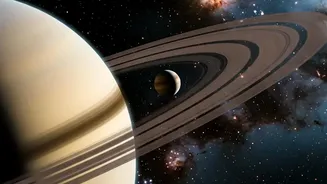
This growing mountain of evidence has solidified Enceladus as a top-priority target for future life-detection missions. Several concepts are already in development. NASA's proposed flagship mission is the Enceladus Orbilander, an ambitious project that would first orbit the moon for a year and a half, repeatedly flying through the plumes to analyze their content with advanced instruments. Afterward, it would land on the icy surface for a two-year mission to study the material up close. The European Space Agency (ESA) is also moving forward with plans for a similar orbiter and lander mission, potentially launching in the 2040s. These missions are being designed specifically to answer the ultimate question: is there life in Enceladus's ocean?