




So, What Is a Microblazar?
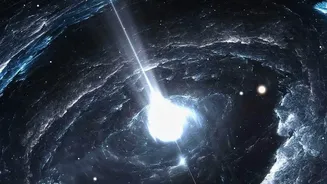
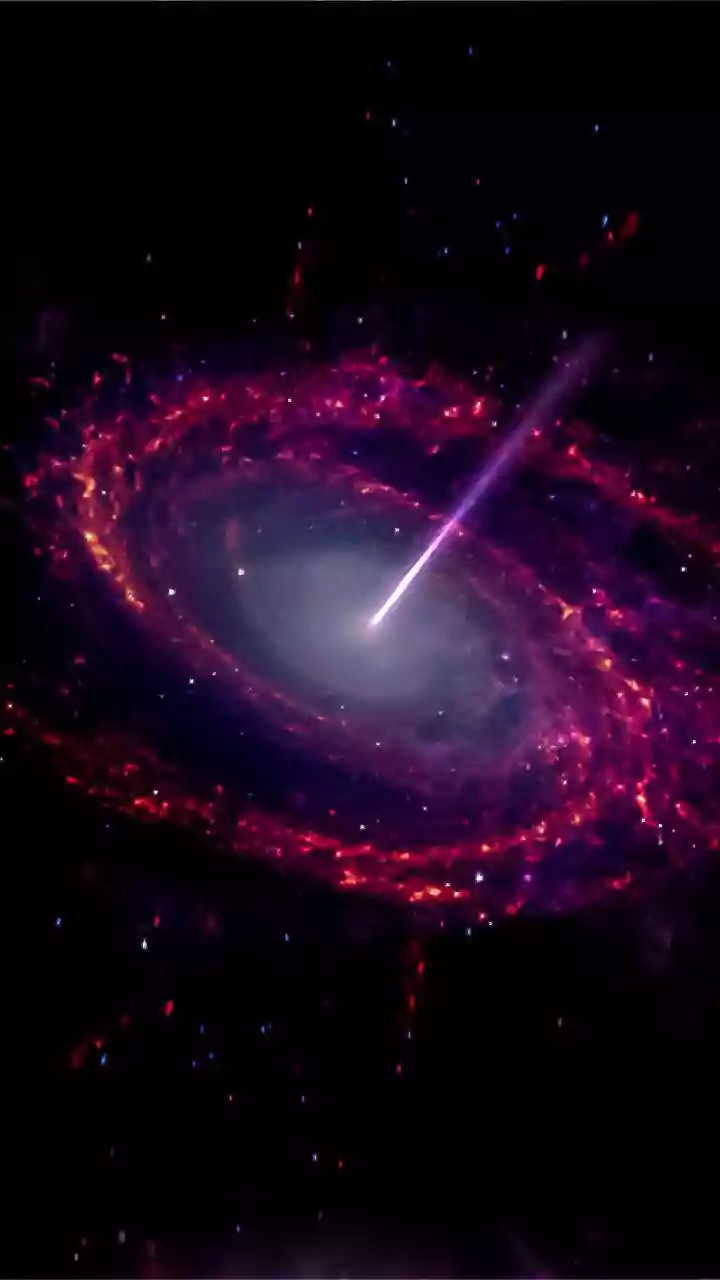
Imagine a supermassive black hole, millions of times heavier than our sun, sitting at the center of a distant galaxy. As it gobbles up surrounding gas and dust, it can blast out colossal jets of energy and particles. If one of those jets happens to be
pointed straight at us, we call it a 'blazar'. Now, scale that whole picture down. A microblazar is the same idea but in miniature, featuring a much smaller, 'stellar-mass' black hole, perhaps only ten times the mass of our sun. These objects are binary systems where the black hole strips material from a nearby companion star, using that stolen matter to power its jets. For over 30 years, astronomers have theorized that these systems must exist in our own galaxy, but they have been notoriously hard to find.
Meet the Candidate: IRAS 18293-0941
The system stirring up all this excitement is called IRAS 18293-0941. Located about 12,000 light-years away in the constellation Scutum, it was first logged in 1983 but remained a mystery for decades, hidden from view by thick clouds of interstellar dust. It took the combined power of modern radio telescopes to finally pierce the veil and reveal what was hiding in plain sight. At its heart is a black hole about 10 times the mass of the sun, locked in a tight 11-day orbit with a massive, hot star. The black hole's immense gravity pulls material away from its companion, creating a swirling, superheated disk of matter that fuels the system's incredible power source.
A Jet Aimed Our Way
The defining feature that makes IRAS 18293-0941 a microblazar candidate is its relativistic jet. This is a focused beam of plasma and charged particles launched from the black hole's poles at a staggering 75% of the speed of light. Crucially, one of these jets is pointed almost directly at Earth. This unique alignment has a powerful effect called 'relativistic beaming' or 'Doppler boosting', which dramatically amplifies the jet's brightness from our perspective and makes the receding jet almost invisible. This is why initial radio observations of the system seemed curiously one-sided, a key clue that led researchers to suspect they were looking at something special.
A Cosmic Laboratory in Our Backyard
While the idea of a particle beam aimed at Earth sounds alarming, its 12,000-light-year distance means it poses no threat. Instead, its discovery is a massive win for science. Blazars are billions of light-years away, making them difficult to study in detail. IRAS 18293-0941 provides a natural laboratory to study these extreme phenomena right here in the Milky Way. Because it is a much smaller system, events and changes happen on much faster timescales—days or weeks, rather than centuries. This allows scientists to watch the physics of jet formation and evolution play out in something closer to real-time, offering an unprecedented look at one of the universe's most powerful engines.
Solving a High-Energy Mystery
The discovery could also help solve another cosmic puzzle: the origin of some of the most energetic particles in the universe. Astronomers have noted that IRAS 18293-0941 is located near a known source of ultra-high-energy gamma rays. The jet that is not pointed at Earth appears to be slamming into a dense molecular cloud about 100 light-years away from the black hole, creating a massive shockwave or 'hotspot'. Scientists theorize that this collision acts as a gigantic particle accelerator, and could be the source of these mysterious high-energy particles that rain down on our galaxy.