



What is the 'Catch' Anyway?
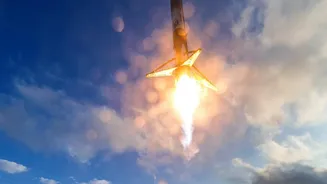
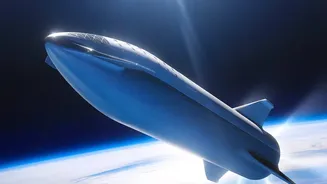
The 'catch' refers to SpaceX's novel method for recovering its massive Starship launch vehicle. The system consists of two parts: the Super Heavy booster and the Starship upper stage. Instead of landing on legs like the company's workhorse Falcon 9 rockets,
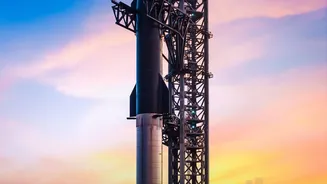
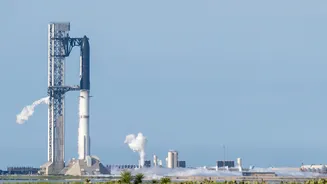
the plan is for both the booster and the ship to fly back to the launch site and be caught in mid-air by a set of huge mechanical arms on the launch tower. This tower, unofficially nicknamed 'Mechazilla' by CEO Elon Musk, is designed not just to launch the rocket, but to serve as its landing pad as well. The historic Flight 15 on November 13-14, 2026, marked the first time SpaceX successfully caught the Starship upper stage after it completed an orbital mission, a major milestone in this ambitious campaign.
Why Not Just Land on Legs?
The decision to catch the rocket is a calculated engineering trade-off driven by the immense scale of Starship and the economics of reuse. Adding landing legs strong enough to support the colossal, 72-meter-tall Super Heavy booster would add significant weight. Every kilogram dedicated to landing gear is a kilogram that can't be used for payload or fuel. By removing the legs and integrating the landing hardware into the ground-based tower, the rocket becomes lighter and more efficient. This 'mass-to-orbit' saving is critical for making missions to the Moon and Mars economically viable. Furthermore, catching the booster directly at the launch mount eliminates the need to transport it from a separate landing zone or a drone ship at sea, dramatically shortening the time it takes to inspect, refuel, and relaunch it. This rapid turnaround is essential for achieving the high launch frequency needed for large satellite constellations and future interplanetary missions.
How the 'Chopsticks' Work
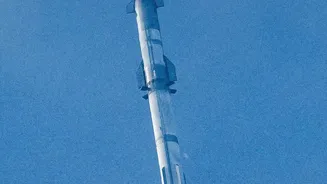
The catch arms, or 'chopsticks', are two large, actuated structures mounted on the launch tower. As the Super Heavy booster or Starship vehicle descends, it uses its engines for a final braking burn to slow itself down and hover near the tower. The vehicle steers itself using small, powerful grid fins to align with the tower's arms. The arms then close around the vehicle, gripping it at reinforced hard points just below those grid fins and lifting it securely back onto the launch mount. The entire process is automated, relying on the vehicle's guidance, navigation, and control system to ensure it arrives at the correct position, altitude, and velocity for a safe capture. If the system detects any deviation from the precise parameters, it will automatically abort the catch attempt and divert the vehicle to a safe splashdown area, as was the case with the booster during Flight 15.
The Significance of Flight 15
While SpaceX had previously caught its Super Heavy booster, Flight 15 was the first attempt to perform a 'double catch,' recovering both the booster and the Starship upper stage from a single mission. The booster's attempt was aborted due to a low fuel reading, leading it to a controlled splashdown in the Gulf of Mexico. However, the mission was a resounding success for the upper stage. After launching, deploying 26 Starlink satellites, and orbiting the Earth 14 times over 22 hours, the Starship vehicle performed a deorbit burn, survived a fiery atmospheric reentry, and flew itself back to the launch site. There, it successfully maneuvered into the waiting arms of Mechazilla, marking the first time in history an orbital-class upper stage has been recovered in this manner. The achievement proved that the hardest part of the recovery process—returning a vehicle from orbital velocity—is possible.
The Path to Full Reusability
The successful ship catch during Flight 15 is a transformative step toward SpaceX's goal of a fully and rapidly reusable launch system, which is seen as the key to dramatically lowering the cost of access to space. An aircraft-like operational tempo—where a vehicle can land, refuel, and fly again in hours or days, not weeks—changes the economics of spaceflight entirely. This capability is a prerequisite for building out the next generation of mega-constellations like Starlink and for enabling ambitious missions that require multiple launches in a short period, such as refueling a Mars-bound Starship in Earth orbit. While Flight 15 did not achieve the full double catch, it validated the most challenging part of the architecture and brought SpaceX one giant leap closer to making routine, affordable space travel a reality.