


A Fleeting Mystery in the Rings
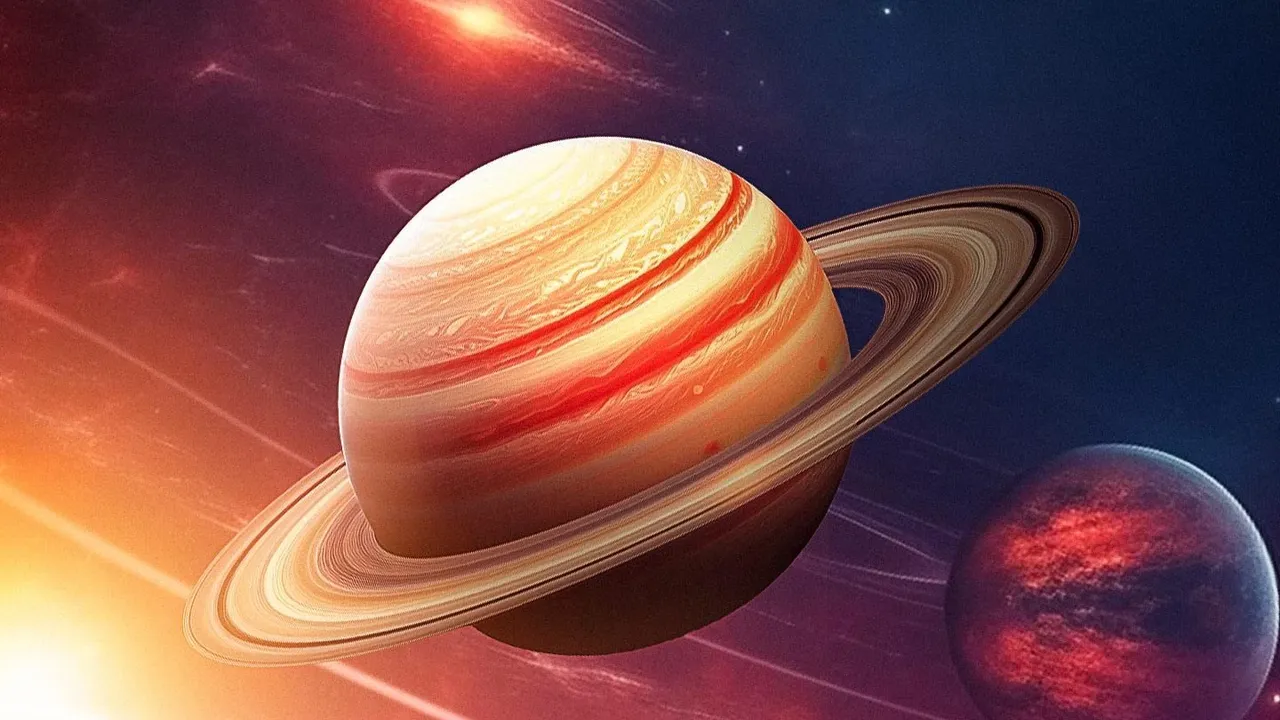
First spotted by the Voyager 2 spacecraft in the early 1980s, Saturn's spokes are transient, radial markings that stretch across the planet's vast ring system. They are not physical structures but rather temporary disturbances that can appear wider than
the diameter of Earth. These features rotate with the rings but typically last for only two or three rotations before fading away, making them a fascinating, fast-moving puzzle. While they may look small against the backdrop of the enormous gas giant, their scale is immense, and their behaviour defies simple gravitational explanations. Their movement suggests they are influenced by forces other than the simple orbital mechanics that govern the billions of ice and rock particles in the rings.
The Seasonal Enigma
One of the most intriguing aspects of the spokes is their seasonal nature. Much like Earth, Saturn has seasons, though each one lasts for about seven years due to its nearly 30-year orbit around the Sun. The spokes are most prominent and frequent around Saturn's equinox, when the rings are tilted edge-on to the Sun. Conversely, they tend to disappear entirely during the planet's summer and winter solstices. This cyclical behaviour strongly suggests a link between the spokes and the angle of sunlight hitting the rings. As Saturn’s northern hemisphere autumnal equinox approaches in May 2025, scientists have been anticipating a ramp-up in spoke activity, with the features becoming more frequent and darker.
Hubble's Unblinking Eye
With NASA's Cassini mission to Saturn having ended in 2017, the mantle of observing these phenomena has fallen to the Hubble Space Telescope. Through its Outer Planet Atmospheres Legacy (OPAL) program, Hubble conducts yearly observations of the solar system's outer planets, creating a vital long-term record of their atmospheric changes. The latest images provide a crucial data point in what scientists call "spoke season." Because the appearance and duration of spokes can be unpredictable, consistent monitoring from Hubble is key to building a comprehensive picture of how they form, evolve, and dissipate over time. These regular check-ins ensure that scientists can track the full lifecycle of these features.
Chasing the Cause
So, what causes these ghostly markings? The leading theory is that the spokes are connected to Saturn's powerful magnetic field. Scientists suspect that when the rings are at a specific angle to the Sun, interactions between solar wind and the planet's magnetosphere create a charged environment. This process could temporarily charge the tiniest, dust-sized icy particles in the rings, causing them to levitate above the main ring plane. These clouds of elevated particles then scatter sunlight differently, appearing as dark or light spokes depending on the viewing angle. While this hypothesis is widely accepted, other factors like meteoroid impacts on the rings could also play a role in creating the plasma needed to charge the particles.
Why the Spokes Matter
Studying the spokes isn't just about solving a visual curiosity; it provides a unique window into the complex physics of Saturn's entire system. The rings act as a giant natural laboratory for plasma physics, where scientists can observe interactions between a planet's magnetic field, solar radiation, and dust particles on a massive scale. By tracking the frequency, size, and movement of the spokes, researchers can gather crucial information about Saturn's variable magnetosphere and the properties of the ring particles themselves. Understanding these processes at Saturn helps scientists build better models for how planetary ring systems and magnetospheres behave throughout the universe.