


The Universe’s Ghost Particles
They are called neutrinos, or 'ghost particles', and for good reason. These elementary particles are almost massless, have no electric charge, and barely interact with other matter. Trillions of them are passing through your body every second, completely
unnoticed. They are born in the nuclear furnaces of stars and other high-energy cosmic events. Because they are so unaffected by the forces that govern other particles, they travel across the universe in straight lines, carrying pristine information about their violent origins. For decades, scientists have known they are a crucial ingredient in understanding the cosmos, but their full impact has remained a tantalizing mystery.
A Star's Violent Death
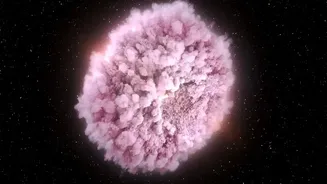
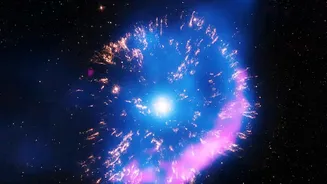
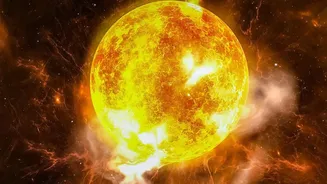
When a star many times more massive than our Sun runs out of fuel, its core implodes under its own immense gravity. This catastrophic event, known as a core-collapse supernova, triggers a process that crushes protons and electrons together to form neutrons, releasing a staggering flood of neutrinos. In fact, about 99% of the colossal energy from a star’s collapse is carried away not by the visible explosion, but by this invisible tide of neutrinos. For an explosion to happen, some of this neutrino energy must be deposited back into the star's outer layers, reheating them and driving the massive blast we see as a supernova. If that reheating fails, the star continues to collapse, forming a black hole.
A Crucial Change of 'Flavor'
The latest research focuses on a bizarre quantum property of neutrinos: they come in three 'flavors' (electron, muon, and tau) and can switch between them as they travel. This phenomenon, called neutrino oscillation or flavor conversion, was previously thought to have a negligible effect on the outcome of a supernova. However, new simulations from researchers at the University of Copenhagen suggest otherwise. They found that inside the incredibly dense environment of a collapsing star, neutrinos are packed so tightly that they interact with each other, triggering rapid flavor changes. This is critical because different flavors interact with matter differently, altering how effectively they can reheat the star and power an explosion.
Flipping the Cosmic Coin
By simulating the collapse of 195 stars with various masses, the researchers found that including neutrino flavor conversion in their models had a dramatic effect. Stars that were expected to explode comfortably as supernovae in standard simulations suddenly failed to do so and collapsed into black holes when flavor conversion was added. The effect was especially pronounced for stars between 16 and 30 times the mass of our sun. Essentially, the subtle change in neutrino behavior can be the deciding factor that tips the scales, making it significantly more likely for a star to collapse directly into a black hole without a bright, visible supernova.
Solving Long-Standing Puzzles
This refinement could help solve several astronomical mysteries. For instance, astronomers observe fewer supernovae in the universe than theoretical models predict. If more stars are collapsing quietly into black holes, as this new model suggests, it could account for the missing explosions. It may also explain why the most massive red supergiant stars sometimes seem to simply vanish without a trace. Furthermore, the models incorporating flavor change tend to produce less massive neutron stars, which aligns better with the masses of neutron stars that have actually been observed. By paying closer attention to the physics of these ghost particles, we get a much clearer picture of how the most extreme objects in our universe are born.