




Meet Your Remodeled Neighbor, GJ 3378 b
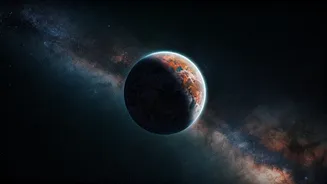
Imagine a world about twice the size of Earth, orbiting a star so close that, in galactic terms, it's practically on our doorstep. This is GJ 3378 b, an exoplanet located a mere 25 light-years from us. For perspective, our Milky Way galaxy is about 100,000
light-years across, making this planet a true next-door neighbor. Discovered orbiting a red dwarf star, which are the most common type of stars in our galaxy, planets like GJ 3378 b have long been prime targets in the hunt for worlds beyond our own. Because of its size—larger than Earth but smaller than giants like Neptune—it earned the nickname 'Super-Earth'. But for a while, there was a major catch that put a damper on its potential for habitability.
The Heavyweight Problem
Previously, astronomers estimated GJ 3378 b to have a mass about five times that of our own planet. While that might not sound extreme, in planetary science, mass is destiny. A planet that heavy is likely to have held onto a thick, crushing atmosphere of hydrogen and helium, more like a miniature Neptune than a rocky, terrestrial world. Such an atmosphere would create immense surface pressure, making the existence of liquid water—and life as we know it—impossible. This 'heavyweight' status made GJ 3378 b an interesting data point, but not a leading contender for a potentially habitable world. It was a classic case of a planet that seemed promising from a distance but less so upon closer inspection.
A Game-Changing Discovery
Everything changed with a study published on June 30, 2026, in The Astrophysical Journal. A team of astronomers, using advanced instruments to observe the planet's gravitational tug on its star, dramatically revised their estimates. They found that GJ 3378 b has a mass of only about 2.3 times that of Earth. This discovery is a game-changer. Halving the planet's estimated mass makes it far more likely that it is a dense, rocky world like Earth or Mars, rather than a gas-shrouded giant. This single revision catapulted GJ 3378 b from a curiosity to one of the most exciting nearby targets in the search for life. It transforms the planet into a place where the conditions for liquid water could genuinely exist, provided other factors align.
Prime Real Estate in the Habitable Zone
This new, lighter profile is made even more exciting by the planet's location. GJ 3378 b orbits within its star's 'habitable zone', often called the 'Goldilocks zone'. This is the orbital region where it is not too hot and not too cold for liquid water to potentially exist on a planet's surface. In fact, GJ 3378 b receives about 90% of the starlight that Earth gets from the Sun, putting it right in the sweet spot for temperate conditions. This combination of having a potentially rocky composition and residing in a temperate orbit is precisely what astronomers look for when prioritizing which exoplanets deserve a closer look with our most powerful telescopes.
The Final Frontier: Is There an Atmosphere?
Despite the newfound optimism, a critical question remains: does GJ 3378 b have an atmosphere, and if so, what is it like? The planet's close orbit, which gives it a 'year' of just 21 days, exposes it to intense radiation from its star. Scientists describe this as being on the edge of the 'cosmic shoreline', a region where a star's energy can be strong enough to strip a planet's atmosphere away over time, much like what is believed to have happened to Mars. Determining if GJ 3378 b has managed to hold onto a stable atmosphere is the next major hurdle. Answering this will likely require future, more powerful observatories, such as NASA's planned Habitable Worlds Observatory, which will be designed to directly image planets like this and analyze their air for signs of water, oxygen, or other biosignatures.