





A Neighbour Under the Microscope
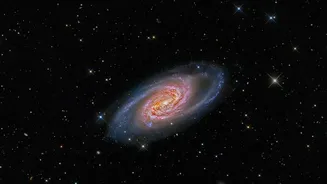
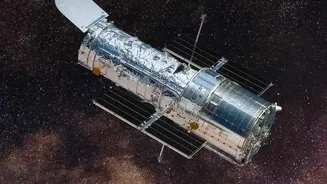
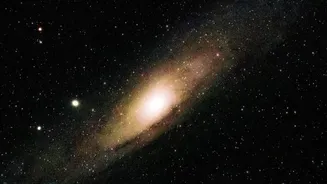
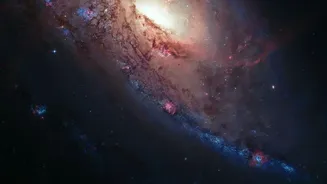
At 2.5 million light-years away, the Andromeda galaxy (M31) is a cosmic sibling to our own Milky Way. It is close enough to be seen with the naked eye from a dark sky and near enough for the Hubble Space Telescope to resolve hundreds of millions of its
individual stars. This unique position makes it a perfect laboratory for understanding how large spiral galaxies form and evolve. For years, astronomers have been conducting a massive survey called the Panchromatic Hubble Andromeda Treasury (PHAT), which has mapped about two-thirds of the galaxy's sprawling disk in incredible detail across multiple wavelengths of light. By analysing this treasure trove of data, scientists can essentially perform cosmic archaeology.
Uncovering a Star-Making Slump
The latest findings, published in The Astrophysical Journal, reveal a significant slowdown in Andromeda's star production. While astronomers knew the galaxy had a major burst of star formation about 2 billion years ago, this new analysis shows that for the last 500 million years, the rate has been steadily declining. About 500 million years ago, Andromeda was creating stars at a rate of about one solar mass (the mass of our sun) per year, similar to the Milky Way's current rate. But that rate has been tapering off, experiencing an even steeper drop in just the last 40 million years. Today, Andromeda’s star formation rate has plummeted to just one-fifth of a solar mass per year. This 'quieter phase' suggests the galaxy is entering a more settled period of its life.
Reading the Galactic Fossil Record
So how do scientists read a galaxy’s history from millions of light-years away? The answer lies in the stars themselves, which act as a 'fossil record' of past activity. Massive stars burn hot and blue, but live very short lives, so their presence indicates recent star birth. Less massive stars are redder and live for billions of years, representing older populations. By analysing the colour and brightness of the 200 million stars in the survey, researchers can map out when and where stars formed throughout Andromeda's history. The team divided the galaxy into thousands of smaller regions to build a comprehensive, high-resolution timeline of its star-making activity.
A Tale of Two Galaxies
This detailed history highlights the different evolutionary paths of Andromeda and our own Milky Way, despite them being neighbours. Andromeda appears to have had a more turbulent past, possibly involving a major merger with another galaxy a few billion years ago that triggered its last big starburst. Since then, it has been winding down. Most of the recent decline in star formation is concentrated in a prominent ring about 32,000 light-years from the galaxy's centre. This ring, once a hotbed of activity, is now fading, driving the overall slowdown. One potential culprit for a localised dip in star creation is the dwarf satellite galaxy M32, whose close pass may have disrupted a portion of Andromeda's disk.
What This Means for Our Cosmic Future
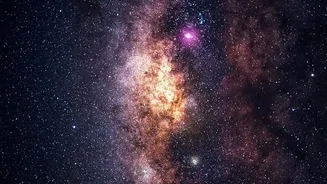
Studying Andromeda's life cycle provides invaluable context for our own. It helps astronomers refine models of how spiral galaxies mature, moving from active, star-forming states to quieter phases. This knowledge is especially relevant given that the Milky Way and Andromeda are on a collision course, set to merge in about 4 billion years to form a new, larger galaxy. Understanding the current state and history of both galaxies provides a more complete picture of what to expect from this future cosmic mashup. By looking at our neighbour, we learn not just about its past, but gain a clearer perspective on the story of our own galaxy and its place in the universe.