






Humanity's first attempt to change the course of a celestial body, NASA's DART mission, was a smashing success. But as the dust settles, new research reveals a sobering reality: deflecting a killer asteroid is much more complicated than we thought.
A Smashing Success with a Caveat
In
2022, the world watched as NASA's Double Asteroid Redirection Test (DART) spacecraft intentionally collided with Dimorphos, a small moonlet orbiting the larger asteroid Didymos. The goal was simple: to prove that a 'kinetic impactor' could physically nudge an asteroid and alter its path. The mission surpassed all expectations. The impact shortened Dimorphos's orbit by a stunning 33 minutes, more than 25 times the minimum benchmark for success. This proved that the principle works and that the recoil from the rock and dust blasted into space—called ejecta—provided a much stronger push than the impact alone. It was a watershed moment for planetary defense, demonstrating that humanity isn't entirely helpless against a potential future threat.
The Shape of the Problem
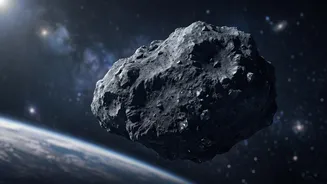
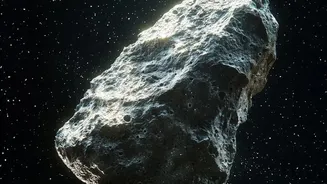
While DART's success was celebrated, scientists knew it was just one test on one type of asteroid. Recent simulations from researchers at Sandia National Laboratories have highlighted a critical variable that was previously underestimated: the asteroid's shape. For decades, computational models simplified asteroids as spheres to make the incredibly complex physics calculations manageable. However, as missions like Japan's Hayabusa2 have shown, asteroids are rarely round. They are often lumpy, irregular 'rubble piles' held together loosely by gravity. The new study, published in the journal Icarus, reveals just how much these irregular shapes matter.
Why Aim Is Everything
The Sandia Labs team developed a new, much faster algorithm that can finally model realistic, lumpy asteroid shapes with high-fidelity math. Their findings are startling. When simulating a deflection attempt using a nuclear detonation—a proposed method for large or last-minute threats—they found that where the blast hits makes a huge difference. For one simulated asteroid, hitting it from one angle produced nearly five times more deflection velocity than hitting it from another. On another simulated asteroid, the impact's effect on its spin varied by a factor of 17 depending on the aim point. As lead researcher Nathan Moore put it, they expected aim to matter, but were surprised by how much. Choosing the right spot could mean a successful deflection, while guessing wrong could have minimal effect or, worse, cause the asteroid to fracture into multiple threats.
The Future of Planetary Defence
This new research doesn't diminish the success of DART. Instead, it adds a crucial layer of sophistication to our understanding. It shows that the next phase of planetary defense isn't just about building bigger impactors, but about getting smarter. Before attempting to deflect a potentially hazardous object, we need to know as much about it as possible: its exact shape, its rotation, and its composition. This requires advanced warning, which is the goal of upcoming projects like NASA's NEO Surveyor, an infrared space telescope designed to find and track potentially hazardous asteroids. The new models also underscore the importance of followup missions like the European Space Agency's Hera, which will visit the Didymos–Dimorphos system in late 2026 to conduct a detailed 'crime scene investigation' of DART's impact. These missions will provide the realworld data needed to refine these new, more precise models.