



The Universe’s Biggest Ghost
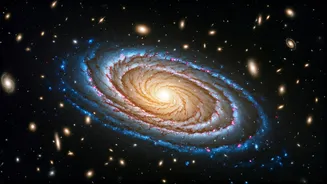
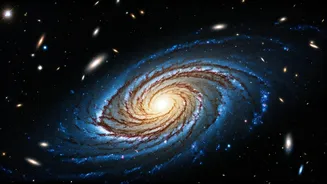
For decades, astronomers have known something was missing. Galaxies spin so fast they should fly apart, but they don't. There's an unseen glue holding them together. Scientists call this mysterious substance dark matter. It makes up about 85% of all matter in the cosmos,
yet it remains completely invisible. It doesn’t emit, absorb, or reflect any light, making it impossible to see directly. The only reason we know it exists is because of the gravitational pull it exerts on the things we can see, like stars and entire galaxies. It acts as a cosmic scaffold, a vast, invisible web upon which the luminous structure of the universe is built. Without it, galaxies as we know them likely wouldn't exist.
A New Detective on the Case
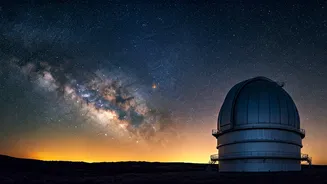
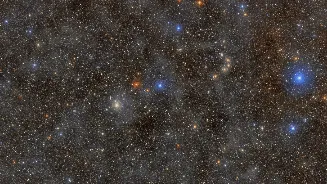
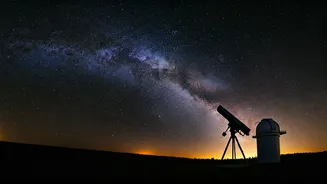
Enter the Vera C. Rubin Observatory. Perched high in the Chilean Andes, this ground-based telescope is not just another observatory; it's a discovery machine. Its main mission is a decade-long project called the Legacy Survey of Space and Time (LSST), which officially began operations at the end of June 2026. Armed with the world’s largest digital camera—a 3,200-megapixel behemoth—the observatory will scan the entire southern sky every few nights. This will create an unprecedented time-lapse movie of the universe, capturing billions of stars and galaxies in extraordinary detail. The observatory is aptly named after Vera Rubin, the pioneering astronomer whose work in the 1970s provided some of the most convincing evidence for dark matter's existence.
How to See the Invisible
So how can a telescope that sees light find something that is defined by its darkness? The answer lies in a clever technique called gravitational lensing. According to Einstein's theory of general relativity, massive objects bend the fabric of spacetime, causing light to curve as it passes by. Dark matter, having mass, does this too. As light from extremely distant galaxies travels toward us, its path is slightly distorted by the gravity of dark matter clumps that lie in between. This effect, known as weak gravitational lensing, causes the distant galaxies to appear subtly warped. These distortions are tiny and imperceptible for a single galaxy, but the Rubin Observatory was specifically designed to measure them for billions of galaxies. By statistically analyzing these tiny warps across the sky, scientists can create a detailed map of all the intervening mass, most of which is dark matter.
A Decade-Long Search for Clues
The LSST is not a quick experiment. For ten years, the observatory will gather about 10 terabytes of data every single night. This flood of information will allow scientists to not only create a static map but also to see how the distribution of dark matter has changed over cosmic time. This will provide crucial tests for our theories about the evolution of the universe. By charting the 'clumpiness' of dark matter at different epochs, researchers hope to understand its fundamental properties and its cosmic tug-of-war with dark energy, the mysterious force causing the universe's expansion to accelerate. While weak lensing is the primary tool, the sheer volume of data on galaxy clusters and stellar streams will offer multiple other avenues to probe this cosmic ghost. The goal isn't just to prove dark matter exists—the evidence for that is already overwhelming—but to finally begin to understand what it is.