





A Giant Among Moons
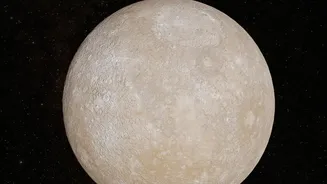
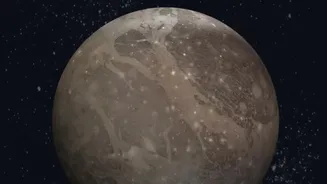
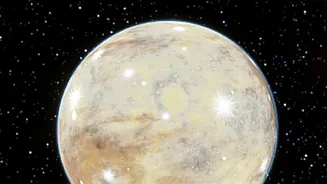
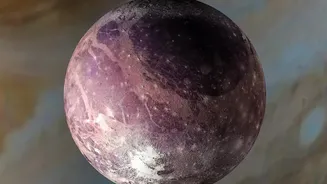
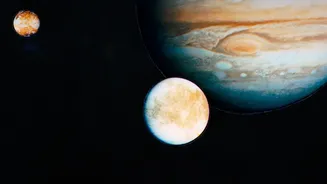
Ganymede is not just any moon; it is the largest natural satellite in our entire solar system. To put its scale into perspective, it is bigger than the planet Mercury and the dwarf planet Pluto. If it were orbiting the sun instead of Jupiter, it would
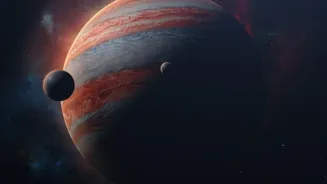
easily be classified as a planet. It is one of the four large moons of Jupiter discovered by Galileo Galilei in 1610, a discovery that fundamentally changed our view of the cosmos. But its size is just the beginning of its intrigue. Uniquely among all moons in the solar system, Ganymede generates its own magnetic field, a feature typically reserved for planets like Earth. This suggests a dynamic, active interior with a liquid iron core, much like our own world.
An Ocean Hiding in Plain Sight
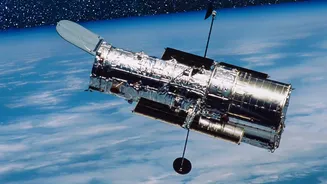
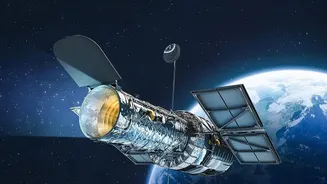
The most compelling reason for Ganymede's stardom is the powerful evidence suggesting a massive saltwater ocean exists deep beneath its icy crust. Scientists estimate this subterranean ocean could be 100 kilometres deep—ten times deeper than Earth's oceans—and may contain more water than all of Earth's surface water combined. This colossal ocean is buried under a formidable ice shell thought to be about 150 kilometres thick. The primary evidence for this ocean comes from a clever study of Ganymede's auroras using the Hubble Space Telescope. Ganymede’s magnetic field creates auroras, or glowing gas ribbons, near its poles. This field is embedded within Jupiter’s much larger magnetic field. As Jupiter rotates, its magnetic field shifts, which should cause Ganymede's auroras to rock back and forth significantly. However, observations showed they rock far less than expected, suggesting the presence of a global, electrically conductive saltwater ocean is creating a secondary magnetic field that counteracts Jupiter's influence.
More Than Just Ice and Water
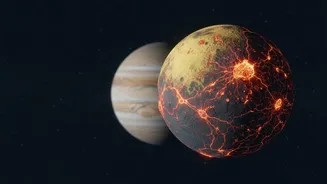
An ocean on its own is exciting, but the specific characteristics of Ganymede's make it even more compelling. Recent observations have detected salts and even organic compounds on Ganymede's surface, which are believed to be remnants of brine that has bubbled up from the ocean below. This suggests the ocean is not just pure water, but a complex chemical soup. Some models even propose a 'club sandwich' structure, with multiple layers of ocean stacked between different phases of ice. Crucially, there is potential for water-rock interactions at the very bottom of this deep ocean. On Earth, such interactions at hydrothermal vents create energy-rich environments that support entire ecosystems, independent of sunlight. The possibility of similar processes on Ganymede is a key driver in assessing its potential habitability.
The Missions to Uncover the Truth
To move from strong evidence to definitive proof, two major missions are turning their focus to the Jovian system. The European Space Agency's (ESA) Jupiter Icy Moons Explorer (JUICE), which launched in 2023, has Ganymede as its primary scientific target. After arriving at Jupiter in 2031, JUICE will perform numerous flybys of Ganymede, Europa, and Callisto before becoming the first spacecraft in history to orbit a moon other than our own, entering a dedicated orbit around Ganymede in late 2034. Its instruments are designed to probe the moon's icy shell with radar, measure its magnetic field, and analyze its surface composition. It will be joined in the Jupiter system by NASA's Europa Clipper, which launched in 2024 and is set to arrive in 2030. While Europa is its main target, Europa Clipper will perform several flybys of Ganymede, providing complementary data and creating an unprecedented opportunity for joint science observations.
The Search for Life's Ingredients
Ultimately, the intense focus on Ganymede is tied to one of humanity's most profound questions: Are we alone? While no one expects to find complex life swimming in Ganymede's ocean, the presence of liquid water, a source of energy, and key chemical elements (like carbon, oxygen, and salts) makes it a prime candidate for potential habitability. These elements are considered the essential building blocks for life as we know it. Missions like JUICE and Europa Clipper are not designed to find life directly but to assess whether the conditions for life could exist. By studying Ganymede in detail, scientists hope to understand how icy ocean worlds form and evolve, not just in our solar system but around other stars. Confirming the nature of Ganymede's ocean will be a monumental step in expanding our list of places to look for life beyond Earth.