




More Than Just a Cosmic Vacuum
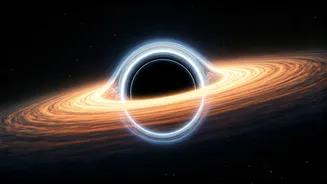
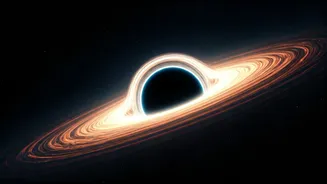
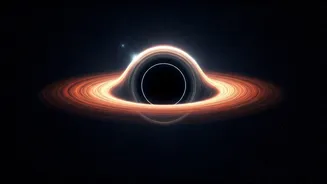
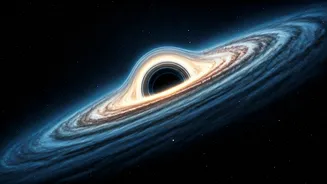
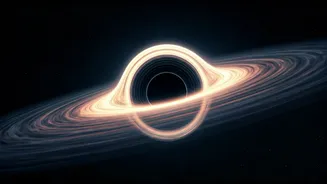
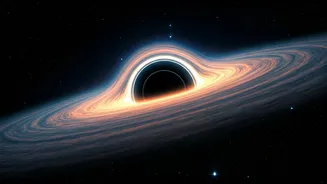
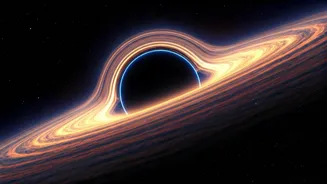
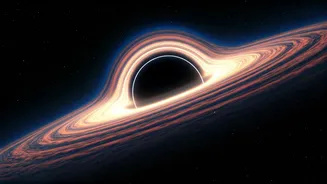
Black holes are famous for pulling things in, but physics has long predicted they should also push material out. As gas and dust are drawn towards a black hole, they form a superheated, spinning plate of material called an accretion disk. While much of this
material is doomed to fall past the point of no return, the intense energy and radiation from the disk can forcefully eject some of it back into space. This outflow is what astronomers call a “black hole wind.” In other galaxies, where supermassive black holes are actively and violently feeding, these winds can be enormous, powerful enough to strip gas out of an entire galaxy. But the black hole at the center of our Milky Way, Sagittarius A (Sgr A), is comparatively quiet, barely sipping on gas. Finding its much gentler wind has been a long-standing challenge.
A Half-Century Cosmic Mystery
The search for this wind from Sgr A has been a 50-year quest. The center of our galaxy is a difficult place to see, shrouded by thick clouds of gas and dust. This makes getting a clear signal from the immediate vicinity of the black hole incredibly difficult. Despite theoretical models insisting that even a quiet black hole must produce a wind, direct evidence remained elusive. Previous hints of past wind activity were found far from the black hole, but there was no proof of a wind currently blowing. The breakthrough required an immense amount of observation time and a novel way of processing the data. A team of astrophysicists from Northwestern University dedicated over 100 hours of observation time over five years, using the Atacama Large Millimeter/submillimeter Array (ALMA) in Chile.
The Five-Year Hunt for a Ghostly Imprint
The research team used ALMA to map the cold molecular gas surrounding Sgr A in unprecedented detail. By developing a new technique to dim the overwhelming radio brightness of the black hole itself, they were able to create an image 80 times sharper than previous maps. In the data, a clear, cone-shaped cavity in the gas appeared, pointing directly away from the black hole. This void, about three light-years long, was the smoking gun. Calculations showed that the energy required to carve out such a feature was far more than nearby stars could produce. The only plausible explanation was a hot wind, blowing from the black hole and clearing the cold gas out of its path.
Confirmation in X-Rays
To be certain they had found the wind, the team cross-referenced their findings with data from NASA's Chandra X-ray Observatory. They found that the cone-shaped hole seen by ALMA was filled with hot, X-ray-emitting gas. This perfect alignment of a void in cold gas and the presence of hot gas confirmed that they were looking at the unmistakable signature of the black hole's outflow. Based on the size of the cavity, the team estimates this gentle but persistent wind has been blowing for at least 20,000 years. The discovery finally shows that Sgr A*, despite its tranquil state, behaves like the supermassive black holes in other galaxies, just on a much quieter scale.