




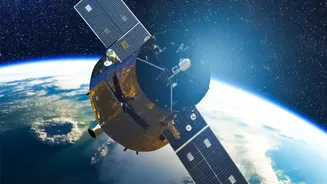

Meet IMAP: Our New Cosmic Cartographer
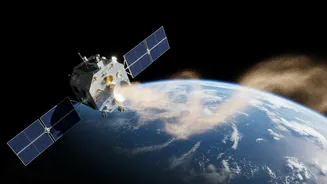
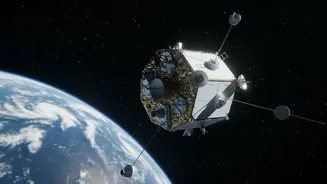
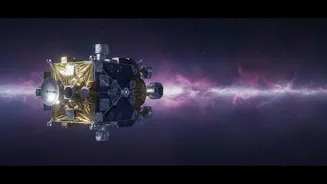
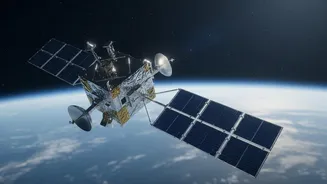
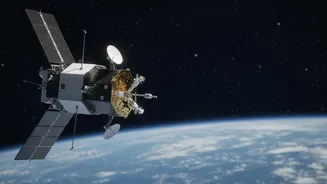
NASA’s Interstellar Mapping and Acceleration Probe, or IMAP, is a state-of-the-art spacecraft with a crucial job: to map the edge of our solar system. Launched in September 2025, IMAP journeyed about 1.5 million kilometres from Earth to a special spot
called Lagrange Point 1 (L1). From this vantage point, it gets an uninterrupted view of the Sun and the particles streaming from it. IMAP is designed to investigate two of the biggest questions in space physics: how particles from the Sun get accelerated to incredible speeds, and how the Sun's output interacts with the stuff of interstellar space. Think of it as a celestial cartographer, equipped with ten sophisticated scientific instruments to draw the first truly comprehensive map of our home in the galaxy.
The Heliosphere: Our Protective Bubble
The "edge of the solar system" isn't a hard line, but a complex, dynamic region called the heliosphere. This massive bubble is created by the solar wind, a constant stream of charged particles flowing outwards from the Sun. This bubble isn't just empty space; it acts as a crucial shield, protecting all the planets, including Earth, from the most harmful high-energy galactic cosmic rays that zip through interstellar space. Without the heliosphere, life on Earth would be exposed to much higher levels of dangerous radiation. Understanding how this shield works, how it's structured, and how it interacts with the galaxy around it is fundamental to understanding our place in the universe. Previous missions, like the Voyager spacecraft, gave us our first hints, but IMAP is designed to paint the full picture.
First Data: Listening to Cosmic Messengers
On August 7, 2026, NASA and Princeton University announced the first public release of science data from IMAP. The data, collected by seven of the spacecraft's ten instruments, is now available to scientists and the public. This initial dataset focuses on particles captured by IMAP, which are like messengers carrying tales from the far reaches of the heliosphere. These particles include ions from the solar wind, interstellar dust, and, most importantly, particles called Energetic Neutral Atoms (ENAs). These ENAs are created when fast, charged particles from the solar wind collide with slow, neutral atoms from interstellar space at the solar system's boundary. Because ENAs are neutral, they travel in straight lines, unaffected by magnetic fields, bringing direct information from the frontier right to IMAP's detectors.
What These Particles Tell Us
The data from instruments like IMAP-Hi, IMAP-Lo, and CoDICE allows scientists to create maps showing where these ENAs come from and what energy they carry. This helps them understand the shape and structure of the heliosphere's boundary, known as the heliosheath. By analysing the types and numbers of different particles—like hydrogen, helium, oxygen, and neon—scientists can piece together the chemical makeup and physical processes happening billions of kilometres away. This is like trying to understand the climate of a distant shore by analysing the sand and shells that wash up at your feet. The initial data confirms that the instruments are working perfectly, capturing a wide range of particles and providing a much clearer picture than was previously possible with missions like IBEX.
Why This Matters for Us in India
This might seem like distant, abstract science, but it has practical implications. The same solar wind that creates the heliosphere also generates space weather. Solar flares and coronal mass ejections can send bursts of energetic particles toward Earth, threatening our satellites, power grids, and communication networks. IMAP is also designed to act as an advanced warning system. Its instruments provide real-time data on the solar wind, giving forecasters a crucial heads-up—about half an hour—on potentially hazardous space weather events. For a tech-driven nation like India, which relies heavily on satellites for everything from weather forecasting to digital payments, this enhanced monitoring capability is incredibly valuable for protecting critical infrastructure.