





A Cosmic Engine in Miniature
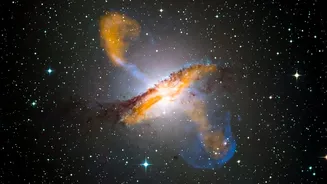
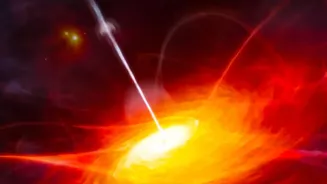
To understand the excitement, we first need to talk about blazars. In distant galaxies, supermassive black holes millions of times heavier than our sun gorge on gas and dust. As they feed, they blast out colossal jets of particles at nearly the speed
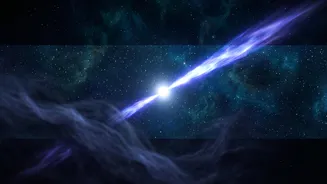
of light. When one of these jets happens to point directly at Earth, we call it a blazar. For decades, astronomers theorized that a smaller version should exist in our own galaxy: a 'microblazar', powered by a stellar-mass black hole just a few times the sun's mass, doing the same thing on a smaller scale. After more than 30 years of searching, scientists believe they have finally found a compelling candidate.
Meet the Candidate: IRAS 18293-0941
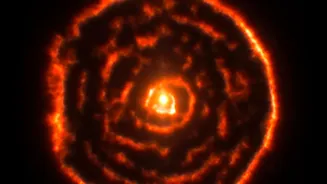
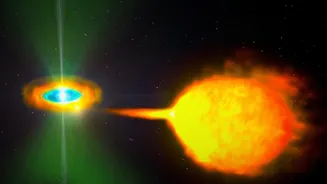
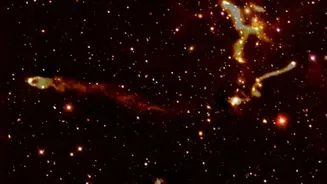
The object at the center of this discovery is IRAS 18293-0941, located about 12,000 light-years away in the constellation Scutum. It was first cataloged in 1983 but was largely forgotten, hidden behind a thick curtain of interstellar dust that made it invisible to optical telescopes. Recent observations using powerful radio telescopes have revealed its true nature: a binary system where a black hole, about 10 times the mass of our sun, is stripping material from a massive companion star. As this material spirals toward the black hole, some of it is funneled into powerful jets. One of these jets appears to be aimed almost directly at Earth, traveling at about 75% of the speed of light.
The Discovery and Its Implications
The discovery is significant because it provides a 'cosmic laboratory' in our own backyard. Microblazars are thought to be incredibly powerful particle accelerators. The jet from IRAS 18293-0941 is seen interacting with a dense cloud of interstellar gas about 100 light-years away. This collision is believed to accelerate particles to petaelectronvolt (PeV) energies, potentially 100 times more powerful than anything achievable at the Large Hadron Collider on Earth. This could help solve a long-standing mystery: the origin of the most energetic cosmic rays that constantly bombard our planet. Because microblazars evolve much faster than their supermassive cousins, they allow scientists to observe these extreme processes on a human timescale.
Why Further Confirmation Is Needed
While the evidence is compelling, scientists are careful to call IRAS 18293-0941 a 'candidate'. The scientific process demands a high burden of proof before a discovery can be officially confirmed. One of the expected signs of a microblazar is rapid flickering in its brightness, caused by the jet pointing toward us, but this has not yet been clearly observed in IRAS 18293-0941. It's possible the surrounding dusty environment is masking these variations. Astronomers will need to gather more data across different wavelengths, looking for this variability and other tell-tale signs to definitively confirm its status. This involves ruling out other possibilities, such as the signal being a background object or an instrumental glitch.