


A Milestone for Indian Space Science
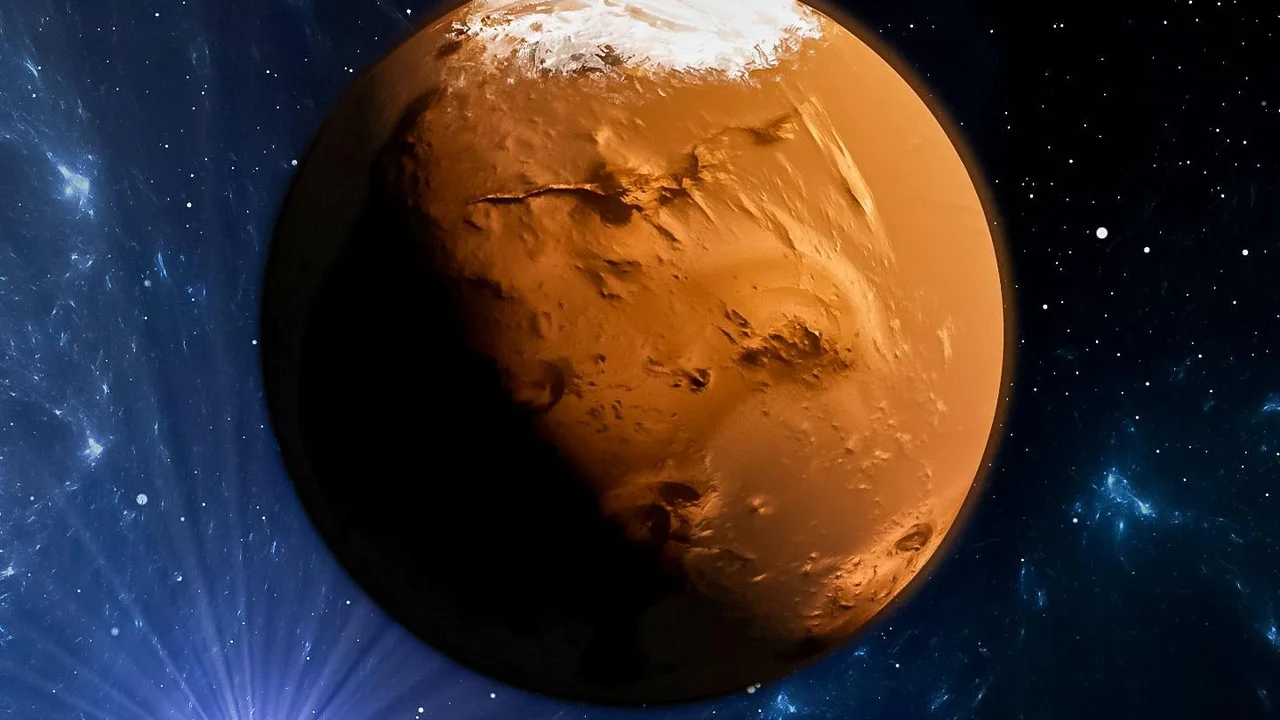
A team of planetary scientists from the Physical Research Laboratory (PRL) in Ahmedabad has unveiled new, detailed insights into the atmospheric dynamics of Mars. Their research provides a comprehensive picture of how temperatures fluctuate across the planet,
governed by its unique seasons and dramatic topography. This achievement builds on India's legacy in Martian exploration, which began with the celebrated Mars Orbiter Mission (MOM), also known as Mangalyaan. While this latest study utilized data from the Emirates Mars Mission's Hope spacecraft, it demonstrates the continued leadership of Indian scientists in analyzing and interpreting complex planetary data. The work, published in the journal Current Science, focuses on how temperature patterns evolve, offering crucial clues for understanding the planet's climate and for planning future missions.
Charting the Red Planet's Extreme Weather
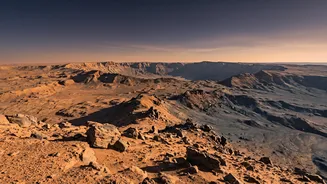
The researchers analyzed infrared data to map surface temperatures, focusing on two massive impact basins, Hellas and Argyre. Their findings paint a picture of a world with extreme thermal shifts. During the southern hemisphere's summer, when Mars is closest to the Sun in its elliptical orbit, surface temperatures can reach a relatively mild 27°C. In contrast, winter temperatures can plummet to a frigid -113°C. These wild swings are largely due to Mars's incredibly thin atmosphere, which is about 100 times less dense than Earth's. This wispy atmospheric blanket is unable to effectively trap and circulate heat, causing the surface to heat up rapidly in sunlight and lose that heat just as quickly after sunset.
More Than Just Seasonal Swings
The PRL team discovered that Martian temperatures don't just rise and fall with the day-night cycle and seasons. They also form large-scale wave patterns that ripple across the planet, heavily influenced by the landscape. The immense depth and unique shapes of the Hellas and Argyre basins, for instance, were found to create complex temperature waves that vary with the season. The researchers also compared their real-world observations to the predictions of the Mars Climate Database, a widely used theoretical model. They found the model was often about 10 Kelvin (10°C) cooler than the actual measurements, highlighting the importance of direct observation in refining our understanding of planetary climates. This discrepancy provides vital information for improving the accuracy of future Martian weather forecasts.
Why This Martian Weather Report Matters
This detailed thermal mapping is more than just a scientific curiosity; it has profound practical implications for the future of Mars exploration. Understanding the extreme temperature changes and atmospheric behavior is critical for designing hardware and planning operations for both robotic and, eventually, human missions. This knowledge helps in selecting safe landing sites, designing habitats that can withstand the thermal stress, and predicting local weather phenomena like winds and dust lifting. In a separate but related study, PRL researchers also developed a 3D model to simulate how local topography like craters and slopes affects temperature, revealing that sun-facing slopes can be up to 30 Kelvin warmer than nearby shaded areas—a detail crucial for rover operations and resource planning. Together, these advancements provide a much clearer picture of the environmental conditions that future explorers will face.