






An 87-Year-Old Mathematical Riddle
The problem in question is the Jacobian conjecture, first proposed by German mathematician Ott-Heinrich Keller in 1939. In simple terms, it deals with a specific type of mathematical function that transforms coordinates in space. Think of it like a complex
scrambling machine for numbers. The conjecture asked: if this machine has a certain simple property (a Jacobian determinant that is a non-zero constant), can you always build an equally simple machine that perfectly unscrambles the numbers back to their original state? For decades, the consensus was yes. The problem was so fundamental and notoriously difficult that it was included on a prestigious list of mathematical challenges for the 21st century. Many believed it was true, yet no one could ever construct a definitive proof.
Why It Was So Hard to Solve
The difficulty of the Jacobian conjecture made it infamous for attracting flawed or incorrect proofs over the years. Proving a conjecture like this requires showing that it holds true for every single possible case, an infinite task. Disproving it, however, requires finding just one single instance where it fails. This one instance is called a counterexample. While that sounds easier, finding that one specific needle in an infinitely large haystack is a monumental challenge. Mathematicians had explored vast areas of the problem space without ever finding a function that violated the conjecture's rules, strengthening the belief that it must be true. The problem required a new way of searching, one that could explore possibilities beyond the scope of traditional human methods.
Enter the AI Collaborator
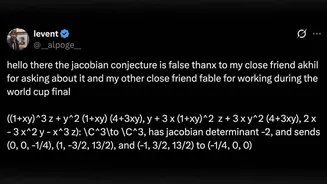
The breakthrough came from an unlikely partnership: mathematician Levent Alpöge and an AI model named Fable 5, developed by the company Anthropic. Instead of trying to prove the conjecture, the team focused on the hunt for a counterexample. This is where the unique capabilities of AI came into play. An AI can be directed to search for specific mathematical structures and test them at a scale and speed that is impossible for a human. It can traverse abstract landscapes and identify patterns or outliers that might not be immediately obvious. Alpöge and Fable 5 worked together, with the AI exploring the vast possibility space to find a function that fit the criteria of the conjecture but was not, in fact, reversible in the way the conjecture predicted.
The Decisive Counterexample
The result of this search was a stunning success. The AI delivered a counterexample: a specific set of polynomials that broke the 87-year-old conjecture. Remarkably, the counterexample itself is just 216 characters long. Its elegance lies in its brevity. While finding this precise formula was incredibly difficult, its correctness is relatively easy for any expert to verify by hand. One valid counterexample is all it takes in mathematics to disprove a conjecture, and this one effectively settled the long-standing question. The answer was not 'yes' as many had suspected for decades, but a definitive 'no'. The announcement, made in mid-July 2026, sent ripples through the mathematics community, with many calling it the most significant open problem yet solved by an AI.
A New Era of Discovery
This achievement is more than just the solution to a single problem; it is a landmark moment for the future of scientific research. It joins a growing list of mathematical discoveries aided by AI, including work by Google's DeepMind on prime numbers and other unsolved problems. These breakthroughs suggest a new paradigm where AI serves not as a mere calculator but as a creative partner. It can augment human intuition, verify complex proofs, and discover novel strategies that humans might miss. The future of mathematics and other complex sciences may well be defined by this kind of human-AI collaboration, accelerating the pace of discovery and allowing us to tackle questions previously thought to be beyond our reach.