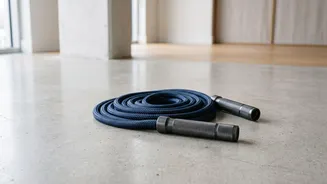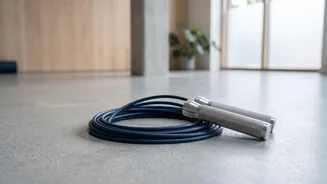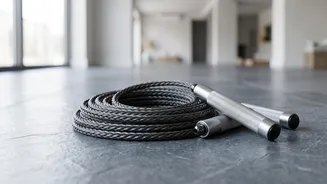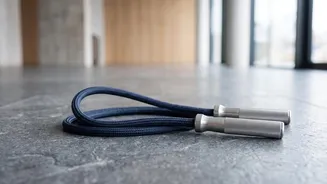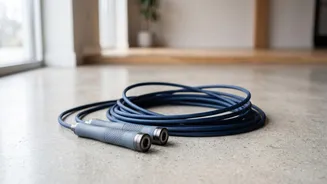







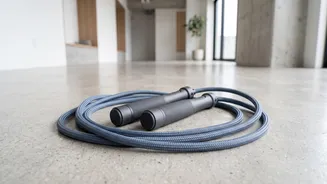
Running and jumping rope are two of cardio's heavy hitters, known for torching calories and boosting heart health. But they also share another powerful, less-discussed benefit: enhancing coordination. How do they compare in this arena?
The Rhythmic Precision of Jumping Rope
At its core, jumping
rope is an exercise in rhythm and timing. The movement pattern is cyclical and contained, demanding a constant, precise synchronisation of the entire body. Your wrists must rotate the rope at a consistent speed, while your feet make small, quick jumps to clear it. This creates a neuromuscular feedback loop where your brain, eyes, hands, and feet are in constant communication to maintain the pattern. Unlike running, where momentum carries you forward, each jump is a distinct event that must be timed perfectly. If your timing is off by a fraction of a second, the exercise stops. This relentless demand for precision is what makes jumping rope such a powerful tool for building whole-body coordination, agility, and a profound sense of rhythm.
The Forward Propulsion of Running
Running, by contrast, is a primarily linear and propulsive movement. Its main coordination challenge lies in maintaining balance and efficiency while moving forward. The pattern involves an alternating motion of the arms and legs to create forward drive and stabilize the torso. While this becomes second nature for experienced runners, it's a complex coordination task that requires the brain to manage balance during single-leg stances, absorb impact, and adjust to changing terrain. The coordination here is less about the rapid-fire, full-body timing of a jump rope and more about sustained locomotor efficiency. It trains the body to orchestrate muscles and joints to move powerfully and gracefully in one primary direction, which is a different, but equally important, form of coordination.
Upper Body vs. Lower Body Engagement
One of the most significant differences lies in how each activity engages the body. Running is a lower-body dominant exercise. While the core is crucial for stability and the arms swing for balance, the primary work is done by the glutes, hamstrings, quads, and calves. Jumping rope, however, is a genuine full-body workout. The lower body handles the jumping, the core must remain braced and tight to transfer energy, and the shoulders, forearms, and wrists are constantly working to control the rope. This makes its coordination demands more comprehensive, forcing the upper and lower body to work in perfect harmony. This is why athletes in sports that require hand-eye-foot coordination, like boxing and tennis, have used jumping rope for decades.
Neurological Demands and Adaptations
Both activities stimulate the brain, but in different ways. Running can become a meditative, almost automatic process where the mind can wander. The coordination required becomes deeply ingrained. Jumping rope demands constant, conscious focus. Learning a new skill like a criss-cross or a double-under forces the brain to create new neural pathways to master the complex timing and movement. This active engagement can improve cognitive function, reaction time, and spatial awareness. Essentially, running perfects a fundamental movement pattern, making it more efficient over time. Jumping rope constantly challenges the brain with new patterns, forcing it to adapt and learn, which can lead to more versatile and responsive motor control.
So, Which Is Better for Coordination?
There isn't a simple winner; the 'better' exercise depends entirely on your goals. If your objective is to develop rhythm, quick feet, agility, and full-body synchronicity, jumping rope has a clear edge. Its demands on timing and upper-and-lower body integration are unparalleled. If your goal is to improve the efficiency and balance of your forward movement, running is the most direct way to achieve that. For many, the ideal solution is not to choose one over the other but to combine them. Jump rope training can make you a better runner by improving your foot strike, calf strength, and proprioception. Meanwhile, running builds an endurance base that allows for longerer intense jump rope sessions.