






Not Fire, Not a Rainbow
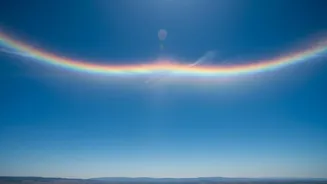
Despite its evocative name, a 'fire rainbow' has nothing to do with fire and isn't a rainbow in the traditional sense. The stunning image shared by NASA is of a circumhorizontal arc. This optical phenomenon occurs not from rain, but from light passing
through ice. While a true rainbow is formed by the refraction and reflection of light in water droplets, creating an arc opposite the sun, a circumhorizontal arc is a member of a different family of atmospheric events called ice halos. These arcs appear as a bright, colourful band running parallel to the horizon, often looking like a fragment of a rainbow that has been flattened out.
The Crucial Role of Ice Crystals
The secret ingredient for a circumhorizontal arc is ice. Specifically, it requires high-altitude cirrus clouds, which are thin, wispy clouds composed of millions of tiny, plate-shaped hexagonal ice crystals. For the phenomenon to occur, these flat, six-sided crystals must be suspended horizontally, like tiny floating dinner plates. Sunlight enters through a vertical side face of the ice crystal and exits through the horizontal bottom face. This 90-degree refraction of light splits the sunlight into its constituent colours, creating the vibrant spectrum we see. The colours are often purer and more distinctly separated than in a typical rainbow.
A Question of Angles
Seeing a fire rainbow is a matter of being in the right place at the right time, under very specific geometric conditions. The most critical factor is the sun's position in the sky. A circumhorizontal arc can only form when the sun is at a very high elevation—at least 58 degrees above the horizon. This is why the phenomenon is more common during the summer months in the mid-latitudes and is impossible to see in locations above 55 degrees latitude, where the sun never gets high enough in the sky. The arc reaches its maximum brightness and intensity when the sun is around 68 degrees high.
Decoding NASA's August 2nd Image
The image featured by NASA's Astronomy Picture of the Day (APOD) on August 2, 2026, was a photograph taken in West Virginia, USA, in 2021. Its selection for the popular daily feature brought renewed attention to this stunning atmospheric event. The accompanying explanation broke down the science, highlighting how the flat, hexagonal ice crystals in the cirrus cloud acted collectively as tiny floating prisms to create the flame-like appearance. By featuring the image, NASA provides a perfect opportunity to educate the public on the difference between common rainbows and the rarer, more specific conditions required for ice halos like the circumhorizontal arc.
How to Spot One
While circumhorizontal arcs are relatively rare, you can increase your chances of seeing one by looking up on bright, sunny summer days when there are thin, high-altitude cirrus clouds. Remember to look high in the sky, as the sun needs to be almost directly overhead. The arc itself will appear below the sun, parallel to the horizon. It's important to differentiate it from other optical phenomena. Cloud iridescence, for example, has more random, pastel-like colours, while circumhorizontal arcs have a clear, spectral band with red on top. Sundogs, another type of ice halo, appear beside the sun, not below it.