
A Cosmic Riddle in Red
In images captured by the powerful James Webb Space Telescope (JWST), astronomers noticed something peculiar: a collection of mysterious 'little red dots' scattered across the infant universe. One, in particular, stood out. Designated MoM-BH-1, this object
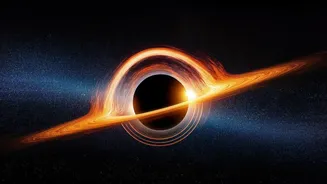
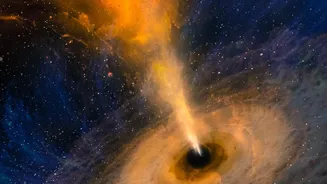
was exceptionally bright and intensely red. It appeared to be the size of our solar system, yet it was producing about 100 billion times more energy than any single star possibly could. This immense power output was more in line with that of a black hole. However, its appearance wasn't right for a black hole, which typically consumes matter through a flat, pancake-like accretion disk. The object was too bright for a star and the wrong shape for a black hole, presenting scientists with a genuine cosmic puzzle. It dates back to just 660 million years after the Big Bang, offering a glimpse into a very young universe.
Meet the 'Black Hole Star'
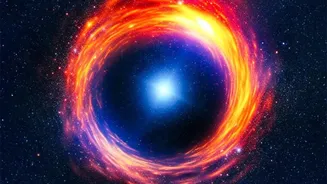
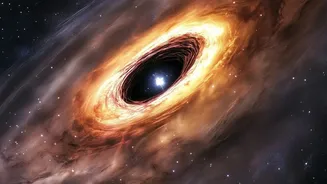
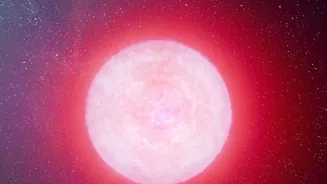
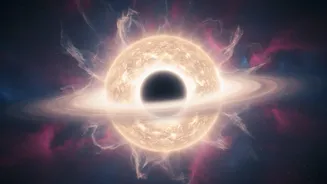
After careful analysis and modelling, an international team of researchers proposed a stunning explanation published in the journal Nature: the object is an entirely new type of celestial body, which they have dubbed a 'black hole star'. This isn't a star in the traditional sense, powered by the fusion of elements at its core. Instead, scientists believe it is a massive black hole, estimated to be 100,000 times the mass of our sun, that is shrouded in an incredibly dense, star-like cocoon of hydrogen gas. In this model, the immense gravitational pull of the central black hole is the engine, heating the surrounding gas and causing it to glow with ferocious intensity. This dense gas envelope acts like the surface of a star, or a 'pseudo-photosphere', creating an object that shines like a star but is powered by a black hole.
Decoding the Red Glow
An object’s red colour in astronomy often points to one of two things: either it is shrouded in dust that scatters blue light away, much like smoke makes a sunset appear red, or its light has been stretched to redder wavelengths by the expansion of the universe, an effect called 'redshift'. Initially, astronomers considered dust, but the light signatures from MoM-BH-1 did not match what they expected. The team discovered that you could achieve this intense red colour without any dust if you have a screen of hydrogen gas so dense that it behaves more like the surface of a giant star than a thin nebula. The object’s extreme distance also contributes to its redness through redshift, confirming its ancient origins in the early universe. Essentially, it's a combination of the object's unique composition and its vast distance from us.
Solving an Even Bigger Mystery
The discovery of this black hole star may solve more than just the identity of one red dot. It could be the key to understanding a major cosmological headache: the existence of supermassive black holes in the early universe. JWST has consistently found black holes millions or billions of times the mass of the sun far earlier in cosmic history than our models predicted they could grow. No one was quite sure how they got so big, so fast. These black hole stars could be the answer. They may represent the birth stage of supermassive black holes, acting as the 'seeds' that rapidly grew into the cosmic giants we see at the centre of galaxies today, including our own Milky Way. If this theory holds, the 'little red dots' seen across the early universe could all be fledgling supermassive black holes, cloaked in their stellar disguises.