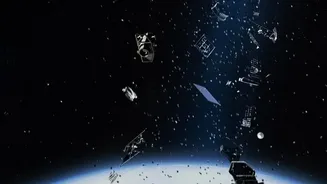







A Junkyard in Orbit
Space debris is any human-made object left in orbit that no longer serves a purpose. This includes everything from defunct satellites and spent rocket stages to tiny flecks of paint and fragments from past collisions. According to space agencies, there
are hundreds of thousands of tracked objects, and millions more that are too small to monitor. The primary danger isn't the junk itself, but its incredible speed. In Low Earth Orbit (LEO), objects can travel at over 28,000 kilometres per hour. At that velocity, even a small fragment can strike an operational satellite with catastrophic force. The greater concern is a cascading chain reaction known as the Kessler Syndrome, a scenario proposed by NASA scientist Donald J. Kessler in 1978. This theory posits that if the density of debris becomes too high, collisions will create more debris, which in turn increases the likelihood of more collisions, potentially rendering entire orbital highways unusable for generations.
The Cosmic Cleanup Crew
A growing number of companies and space agencies are developing technologies for what is known as Active Debris Removal (ADR). These are the 'tow trucks' of space, designed to actively find, capture, and deorbit dangerous junk. Companies like the Japanese firm Astroscale and the Swiss startup ClearSpace are leading the way with innovative solutions. Astroscale has been demonstrating its ability to rendezvous with and inspect debris, while ClearSpace was awarded a contract by the European Space Agency (ESA) for the world's first mission to remove an existing piece of debris. The technologies being tested are varied and include robotic arms to grab satellites, powerful magnets, harpoons to spear derelict rocket bodies, and nets to capture smaller objects. These missions are complex and expensive, but are proving that the core concepts of capturing non-cooperative targets are feasible.
The Challenge of Regulation
For the debris removal market to thrive, there needs to be a clear set of rules. Currently, international space law, largely based on the 1967 Outer Space Treaty, holds nations liable for objects they launch but is vague on the responsibility for cleaning up old junk. For decades, the prevailing guideline was a voluntary 25-year rule, suggesting that satellites should be deorbited within 25 years of their mission's end. However, enforcement has been inconsistent. This is changing. The U.S. Federal Communications Commission (FCC) has implemented a much stricter 5-year deorbit rule for new LEO satellites, a move that effectively creates a future market for end-of-life services. Similarly, the ESA has promoted a 'Zero Debris Charter', aiming to stop generating new debris by 2030. These national and regional regulations are forcing satellite operators to have a disposal plan, creating a powerful incentive for the cleanup market.
Who Pays the Bill?
The $9.57 billion forecast hinges on turning a technical capability into a commercial service someone is willing to pay for. The primary customers are expected to be commercial satellite operators themselves. Companies operating massive satellite 'mega-constellations' for global internet, like SpaceX's Starlink and Amazon's Project Kuiper, have a direct financial interest in keeping their orbital paths clear. A collision could damage not just one satellite, but threaten their entire network. For these operators, paying for a removal service could be far cheaper than losing billion-dollar assets. Satellite insurance companies are also a key driver; as the risk of collision rises, so do premiums, creating a financial case for investing in a cleaner environment. Finally, governments and military agencies, which rely on space for national security, are becoming crucial first customers, funding demonstration missions to spur the development of these technologies.