






When it comes to planetary defense, nudging a dangerous asteroid off-course seems simple enough. But new research suggests it’s not just about how hard you push, but where. A groundbreaking study reveals a surprising twist in our strategy.
The Challenge of Asteroid Defense
For years, scientists
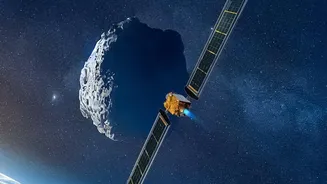
have been developing strategies to protect Earth from a potential asteroid impact. The basic idea is one of deflection: altering an asteroid's trajectory just enough so that its future path misses our planet entirely. Two main methods have been studied: kinetic impactors and nuclear devices. NASA's successful DART (Double Asteroid Redirection Test) mission in 2022 proved that a kinetic impactor—essentially ramming a spacecraft into an asteroid—can indeed change its orbit. However, for larger asteroids or those with very short warning times, the immense energy of a nuclear blast is considered a more powerful, and perhaps necessary, option. The concept involves detonating a nuclear device near the asteroid, flooding one side with X-rays. This instantly vaporizes a layer of the surface, creating a powerful, rocket-like thrust that pushes the asteroid onto a new course.
Why Shape and Aim Are Critical
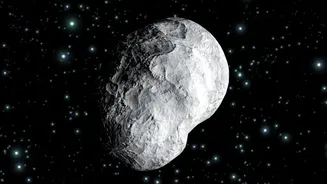
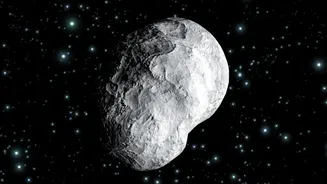
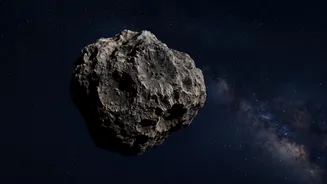
For a long time, simulations of this process made a convenient simplification: they treated asteroids as smooth, uniform spheres. This made the complex physics calculations manageable. But real asteroids are not perfect spheres; they are often lumpy, irregular 'rubble piles' held together by weak gravity. A new study from researchers at Sandia National Laboratories, published in the journal Icarus, has explored this crucial detail using the most accurate asteroid deflection models to date. They found that an asteroid's irregular shape dramatically changes how it responds to a blast. The key takeaway is that the direction of the X-ray burst is just as important as its power.
A Fivefold Difference in Effectiveness
The results of the new simulations were startling. Researchers found that targeting different sides of the same simulated, irregularly shaped asteroid could produce vastly different outcomes. In one simulation, hitting the asteroid from one direction changed its speed by 3.9 millimeters per second. When the blast was directed at another side of the same object, the speed changed by only 0.8 millimeters per second. That represents a nearly fivefold difference in deflection effectiveness, a gap that surprised even the researchers. 'We expected aim to matter,' said Nathan Moore, the Sandia physicist who led the study. 'What surprised us was how much.' A poorly aimed blast could deliver far less of a nudge than expected, potentially making the difference between success and failure in a real-world scenario.
Putting a New Spin on the Problem
The simulations also revealed a dramatic effect on the asteroid's rotation. For one simulated body, the change in how fast it spun varied by a factor of 17 depending on the direction of the blast. This is a critical consideration for mission planners. The primary goal is to redirect the asteroid's path while keeping it intact. An off_center blast could induce a powerful spin that, while helping to alter its trajectory, could also risk breaking the asteroid apart. Creating a cloud of smaller, still_dangerous fragments is a scenario planetary defenders want to avoid. The study highlights that a successful mission must balance achieving the desired push against the risk of causing the asteroid to fracture or spin uncontrollably.
Smarter Models for a Safer Future
This research provides a powerful new tool for planetary defense. The advanced models, which are over 1,600 times faster than previous methods, allow scientists to incorporate both realistic asteroid shapes and highly detailed physics. In principle, if a threatening asteroid were detected, researchers could use its known shape to calculate the optimal explosive yield, distance, and direction needed to safely move it away from Earth. While there are still practical challenges—such as getting a detailed 3D model of an asteroid with little warning time—this work fundamentally improves our understanding. It moves planetary defense from a question of 'how much force?' to a more sophisticated strategy of 'where is the most effective place to apply it?'.