







Why Mumbai is India's Digital Gateway
For decades, Mumbai has been the undisputed entry point for India’s global data traffic. Its strategic location on the west coast makes it the most direct route for data flowing to Europe, the Middle East, and Africa, which accounts for a massive portion
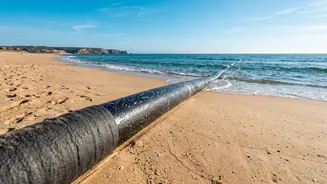
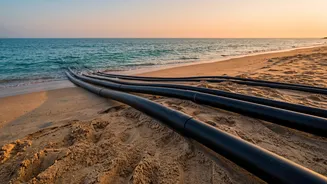
of India's international bandwidth. This geographical advantage, combined with its status as India's financial capital, created a self-reinforcing cycle. As more cables landed, more data centers were built, attracting further investment from telecom giants like Tata Communications, Reliance Jio, and Bharti Airtel, all of whom operate major cable landing stations in or around the city. Today, at least 13 of India's 18 main intercontinental cables come ashore near Versova, handling the vast majority of the country's data.
The Risk of a Single Point of Failure
This heavy concentration, however, creates a significant vulnerability. If this small area were to face a major disruption—whether from a natural disaster like a cyclone, a ship dragging its anchor, or even sabotage—it could severely impact internet connectivity for millions. While traffic can be rerouted through other landing stations in cities like Chennai and Kochi, doing so would increase latency, or the delay in data transfer. For critical sectors like finance, cloud computing, and the burgeoning AI industry, even minor delays can have major consequences. Experts also point out that many of India's existing cables are approaching their 25-year operational lifespan, adding another layer of risk to the nation’s digital backbone.
Diversification: The Race to Build New Routes
Recognizing this risk, both the government and private companies are now in a race to diversify India's cable landing infrastructure. The focus is on creating new, resilient routes that bypass the congested Mumbai corridor. Chennai, on the east coast, is rapidly emerging as a second major hub, providing a crucial gateway to Singapore and the rest of Southeast Asia. New projects are set to dramatically increase India's international bandwidth and spread the load. Major upcoming systems include the 2Africa cable, one of the world's longest, which will connect India to 33 countries; Reliance Jio's India-Asia-Xpress (IAX) and India-Europe-Xpress (IEX) systems; and the SEA-ME-WE-6 cable connecting France and Singapore via India.
The Rise of New Digital Hubs
This diversification is not just about mitigating risk; it's about building a more distributed and robust digital economy. New cable landing stations are planned or are under construction in several other coastal locations, including Digha in West Bengal, Puducherry, and along the coast of Andhra Pradesh. These new entry points are expected to spur the development of data center hubs in these regions, spreading economic opportunities beyond Mumbai and Chennai. For instance, upcoming landings in Andhra Pradesh are strategically placed to serve the massive data centers being built in Hyderabad. This expansion will not only make India's internet more resilient but also support the exponential data growth fueled by 5G, AI, and cloud services across the country.