



A New Look at Our Star
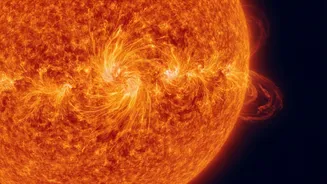
The image that has the scientific community buzzing is not your typical snapshot of the sun. Instead of a uniform yellow ball, it shows a close-up of the sun’s chromosphere, the layer of its atmosphere just above the visible surface. This region appears
as a chaotic landscape of super-heated plasma, structured into intricate patterns by powerful magnetic fields. It resembles a tightly woven carpet of fiery threads, with some structures reaching thousands of kilometres in length. These details, captured in visible light, provide the sharpest view ever obtained of this dynamic area. Scientists can now distinguish features as small as 20 kilometres across on the solar surface—an astonishing feat of observational astronomy, akin to spotting a small coin in Delhi from Mumbai. This clarity moves beyond pretty pictures, offering hard data on the churning, super-hot gas that shapes the sun's behaviour.
The Eye on the Sun
Capturing such an image is a monumental technological challenge. The sun's intense light and heat can damage instruments, and Earth’s own atmosphere blurs incoming light, smudging out fine details. This breakthrough comes from the National Science Foundation's Daniel K. Inouye Solar Telescope (DKIST) in Hawaii, the largest and most powerful solar telescope in the world. Its massive 4-meter primary mirror collects more light than any other solar instrument, providing the base for high-resolution images. The secret weapon, however, is its advanced adaptive optics system. This technology uses deformable mirrors that adjust their shape thousands of times per second to counteract the blurring effect of our atmosphere. It effectively unscrambles the light, allowing the telescope to achieve its theoretical maximum sharpness. A complex cooling system, distributing kilometres of piping and coolant, protects the telescope from the immense heat generated by focusing the sun’s power onto a single point.
From Pretty Picture to Powerful Data
While visually spectacular, the primary purpose of this image is scientific. The newly visible details offer clues to one of the biggest mysteries in solar physics: how energy is transferred from the sun's surface to heat its outer atmosphere, the corona, to millions of degrees Celsius. By studying the movement and interaction of the small-scale plasma structures and magnetic fields, scientists hope to understand the mechanisms that drive the sun's more violent events. These include solar flares and coronal mass ejections (CMEs), massive eruptions of charged particles that can trigger powerful space weather. When directed at Earth, this space weather can disrupt satellite communications, damage power grids, and pose a risk to astronauts. Data from DKIST will be used by researchers at NASA and other institutions to build better predictive models of space weather, ultimately helping to protect our technological infrastructure.
The Future of Solar Observation
This achievement does not exist in isolation. It marks a new era of multi-platform solar science. The ground-based observations from DKIST provide crucial context for missions that are flying much closer to the sun. For instance, NASA’s Parker Solar Probe is currently making daring passes through the sun’s corona, sampling particles and magnetic fields directly. Simultaneously, the joint ESA/NASA Solar Orbiter is capturing images and data from a different vantage point. By combining the close-up, detailed surface view from DKIST with the in-situ measurements from these spacecraft, scientists can build a complete, three-dimensional picture of how our star works. This synergistic approach allows researchers to trace events from their origins on the sun's surface, through its atmosphere, and out into the solar system, connecting the 'what' with the 'why' in near real-time.