





What Exactly Is Nordic Walking?
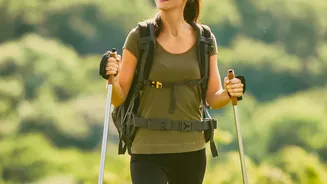
Originating in Finland as a summer training method for cross-country skiers, Nordic walking has grown into a popular global exercise. It involves walking with specially designed poles that are used to actively propel you forward. Unlike hiking, where
poles are often used for stability, in Nordic walking, you use the poles to engage your upper body with every stride. This turns a simple walk into a comprehensive workout that targets up to 90% of your body's muscles, compared to about 50% in regular walking. The result is a low-impact activity that combines cardiovascular exercise with muscle strengthening.
The Full-Body Benefits
The primary advantage of Nordic walking is its efficiency. By recruiting muscles in the arms, shoulders, chest, and back, you significantly increase your energy expenditure. Research shows that Nordic walking can burn up to 46% more calories than regular walking at the same pace. Some studies even report a range of 18% to 67% depending on the intensity and technique. What's remarkable is that for many people, the perceived effort doesn't feel significantly harder than a normal walk. It also improves posture by encouraging an upright stance, can relieve neck and shoulder tension, and is gentler on the joints, making it an excellent option for various fitness levels and ages.
Gearing Up: The Right Poles Matter
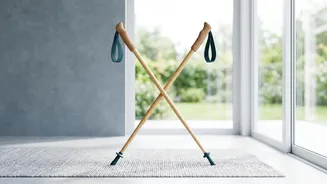
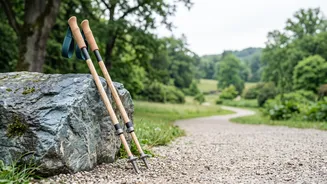
You can't just grab any pair of sticks. Nordic walking poles are distinct from trekking or hiking poles. They are typically lighter and feature a unique glove-like strap system that allows you to push off through the strap and release your grip on the follow-through of your arm swing. This specific design is crucial for executing the correct technique and reaping the full benefits. Poles come in fixed-length or adjustable versions. Fixed-length poles are often lighter, while adjustable poles offer versatility, especially for beginners or for sharing. Many poles also come with removable rubber tips, called 'paws,' for walking on hard surfaces like pavement.
Mastering the Basic Technique
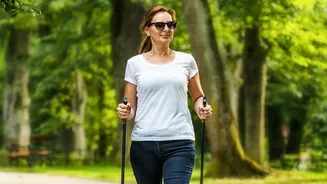
The core of Nordic walking is the coordinated opposition of arms and legs, just like in regular walking, but amplified. The basic pattern is simple: as your left foot moves forward, your right arm swings forward with the pole, and vice versa. Stand tall with your shoulders relaxed. Plant the pole at an angle behind you, roughly midway between your front and back foot. As you step forward, push off the pole to propel yourself. Your arm should extend back, and as it does, you briefly open your hand, pushing off through the strap rather than the grip. This creates a smooth, flowing rhythm that engages your upper body and core.
How to Get Started
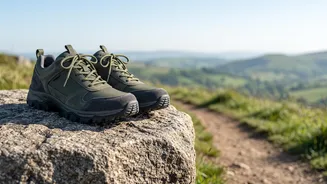
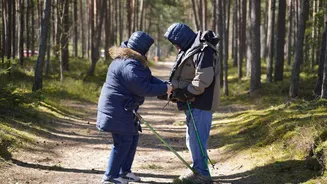
Starting your Nordic walking journey is straightforward. First, invest in proper footwear—comfortable walking shoes with good support are all you need. Begin with shorter sessions of 15 to 20 minutes, focusing on getting the technique right before you try to build speed or distance. Drag the poles behind you at first to get a feel for the rhythm. As you become more comfortable, start planting the poles and pushing off. Many communities and fitness groups offer introductory workshops or classes, which can be a great way to learn the correct form from an instructor and meet fellow walkers. In India, organizations like the Federation of Nordic Walking India are working to build a community around the activity.